



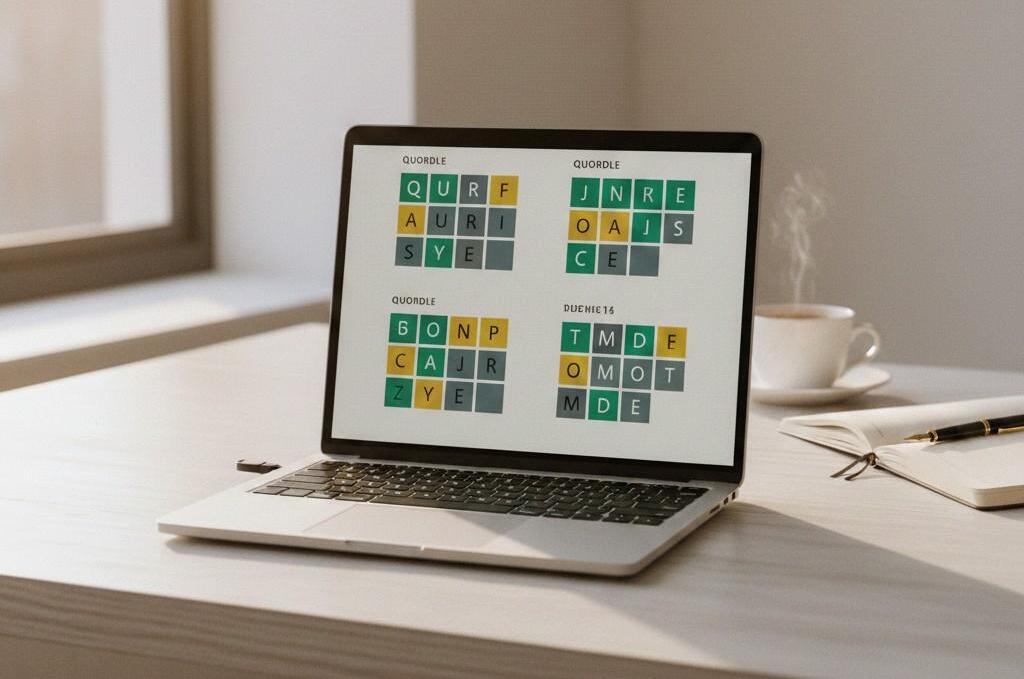
Staring at four empty grids with nine guesses to crack them all—sound impossible? I thought so too, the first time I tried Quordle. After confidently breezing through my daily Wordle in three attempts, I figured this four-word variant would be just a bit trickier. Wrong. I failed spectacularly, watching my streak die on day one.
Here’s what nobody tells you about Quordle: it’s not just four times harder than Wordle—it requires completely different strategies. The approaches that make you a Wordle champion will absolutely wreck you here. But once you understand how to play this beast of a word game, it becomes one of the most rewarding daily puzzles you’ll ever solve.
Whether you’re hunting for Quordle hints today, trying to keep your streak alive, or just discovered this game on the Merriam-Webster website and want to know what the hype is about, I’m going to walk you through everything you need to dominate Quordle.
What Is Quordle?
Quordle is a word puzzle game where players must simultaneously solve four five-letter words within nine attempts. Created by Freddie Meyer and acquired by Merriam-Webster in January 2023, the game uses colour-coded feedback (green for correct placement, yellow for incorrect position, and grey for missing letters) to guide players toward the solution. Unlike Wordle’s single-word challenge with six guesses, Quordle quadruples the difficulty by requiring players to juggle multiple word grids at once, making it one of the most challenging daily word games available.
Why Quordle Became the Wordle Alternative Everyone’s Playing
Remember early 2022 when everyone was sharing those green and yellow squares on Twitter? Quordle launched in February 2022, riding the massive wave of Wordle’s popularity, but it didn’t just copy the formula—it turned it into something genuinely different.
Within weeks of launch, something remarkable happened. Quordle gained one million players in its first two months. Why? Because people who’d mastered Wordle were hungry for a real challenge, not just another clone.
I’ve played dozens of Wordle variations. Most faded into obscurity within months. Quordle didn’t. It’s still going strong because it fundamentally changed the game mechanics. You’re not just guessing more words—you’re managing cognitive load, prioritising information, and thinking several moves ahead like chess.
Here’s what makes Quordle different from standard word games:
The game evolved from an early prototype by engineer David Mah, but Freddie Meyer modified the code after being inspired by Dordle, which challenged players with two grids. Meyer thought: Why not four? The result is a game that demands pattern recognition, depth of vocabulary, and strategic thinking simultaneously.
When Merriam-Webster acquired Quordle in January 2023, it validated what players already knew—this wasn’t just a fad. The dictionary publisher, which has been America’s leading language authority since 1831, saw value in a game that genuinely challenges linguistic skills. As Meyer stated about the acquisition, he couldn’t think of a better home for the game.
The statistics tell the story, too. While many Wordle clones disappeared, Quordle maintains millions of daily players. That staying power comes from one simple truth: it’s genuinely hard but always fair. Every puzzle is solvable with the right strategy.
How to Play Quordle: Rules and Gameplay Mechanics
Let me break down exactly how this works, because if you jump in assuming it’s like Wordle, you’ll burn through your nine guesses before solving even two words.
The Basic Setup:
You see four separate 5×5 grids on your screen. Each grid contains a different five-letter word you need to discover. When you type a guess, that word appears simultaneously in all four grids, and each grid responds independently with colour-coded feedback.
The Colour System:
- Green tiles: The letter is correct and in the right position for that specific word
- Yellow tiles: The letter exists in that word, but you’ve placed it incorrectly
- Grey tiles: The letter doesn’t appear in that word at all
Here’s the twist that catches everyone: a letter can be green in one grid, yellow in another, and grey in a third. Your brain has to track four separate word puzzles using the same pool of guesses.
Your Nine Attempts:
Unlike Wordle’s six guesses for one word, you get nine attempts to solve all four words. This might sound generous, but trust me—it’s not. The math works against you. In Wordle, you can dedicate all six guesses to one word. In Quordle, those nine guesses must serve four different solutions.
Daily vs. Practice Mode:
The Daily Quordle resets at midnight your local time, giving everyone worldwide the same four words to solve—one shot per day, just like Wordle. But Quordle also offers unlimited Practice mode, which is where you should spend your first week. I cannot stress this enough—practice mode is your best friend when learning.
Letter Frequency Matters More:
In Wordle, you can sometimes luck into the answer with random guesses. In Quordle, randomness kills you. You must systematically eliminate letters to maximise information gain from each guess. According to research on English letter frequency, common letters such as E, A, R, S, T, and N require early coverage because they appear across multiple words.
The Keyboard Indicator:
One brilliant Quordle feature: the virtual keyboard splits each key into four quadrants, showing the colour status for each grid. This visual aid helps track which letters work for which words, preventing the mental overload that sinks most beginners.
Winning Looks Like:
You’ve won when all four grids show five green letters. Unlike some games, partial victories don’t count. It’s all four words or nothing. This creates real tension in the final guesses when you’ve solved three but are stabbing in the dark on the fourth.
Proven Strategies to Crush Quordle Every Single Day
Okay, this is where we separate casual players from streak warriors. I’ve maintained a 200+ day Quordle streak, and these strategies are what transformed me from someone who failed half the time to someone who rarely uses more than eight guesses.
Step 1: Master Your Opening Trio
Your first three guesses should accomplish one goal: cover 15 unique letters. Not 10, not 12—fifteen. This is non-negotiable.
I use AUDIO, STERN, and LYMPH. These three words give me all five vowels plus the consonants R, N, S, T, L, M, P, H, Y. That’s 15 of the most common English letters right there. After these three words, I typically have multiple yellow and green letters across all four grids.
Some players swear by different combinations. Try CRANE, LOUSY, and BUMPH. Or STARE, LOUIS, and NYMPH. The specific words matter less than the principle: maximise unique letter coverage in your opening moves.
Step 2: Read the Entire Keyboard, Not Just One Grid
Beginners make this mistake constantly: they focus on one promising grid and ignore the others. Don’t. After each guess, scan all four grids and the colour-coded keyboard. Which word has the most information? Start there, but don’t commit fully.
I trained myself to spend 10 seconds after each guess just looking, processing patterns before typing anything. This pause is crucial. Your brain needs time to recognise patterns across multiple words simultaneously.
Step 3: Solve Easy Words Last, Not First
This sounds counterintuitive, but it’s the single best Quordle strategy. When one word is nearly solved with four green letters, ignore it temporarily. Use your remaining guesses to gather information about the harder words.
Why? Because once you solve a word, that grid goes dormant. You can’t use it for letter testing anymore. Keep difficult words alive as long as possible, using them as testing grounds for uncommon letters.
Step 4: Track Double Letters Carefully
Quordle answers often contain repeated letters. Words like BLOOD, SWEET, or CLASS appear regularly. If you see yellow letters but can’t place them, consider whether the word uses that letter twice.
I once spent five guesses trying to solve a word where I had B_OO_ figured out. I kept trying different consonants: BROOK, BLOOM, BROOD. The answer? DROOL. The lesson: when stuck, question your assumptions about letter frequency.
Step 5: Use the Process of Elimination Aggressively
By guess five or six, you should have enough information to work backwards. Don’t just think “what word could this be?” Think “what word could this NOT be?” Eliminate impossible combinations. If you know positions 2 and 4 are vowels, you’ve immediately cut your options by 60%.
Step 6: Remember Common Word Patterns
Quordle doesn’t often use obscure words. It favours recognisable English words. You can check Merriam-Webster’s dictionary if you’re unsure whether a word is valid. Common patterns help:
- Words ending in -ING, -TION, -NESS
- Words starting with CH-, SH-, TH-, PR-, ST-
- Vowel patterns like -EA-, -OU-, -AI-
When I see EA_, my brain immediately cycles through BEACH, PEACE, HEART, REALM. Pattern recognition becomes automatic with practice.
Pro Tip from Experience:
If you’re down to your last guess with two unsolved words, make an educated guess on the easier one and hope. I’ve had to do this dozens of times. Sometimes you get lucky; sometimes you don’t. But a 50% chance beats zero per cent when you’re out of guesses.
Quordle vs. Wordle vs. Other Word Games: What’s Actually Different
I play six different word games daily. Each has a place, but let’s be honest about what separates them.
Quordle vs. Wordle:
Wordle is meditation. Quordle is CrossFit for your brain. In Wordle, you can coast on good vocabulary and a decent starting word. In Quordle, coasting gets you wrecked.
The key difference? Information management. Wordle lets you hyperfocus on a single word, chasing every possibility. Quordle punishes hyperfocus. You must distribute attention across four challenges while each guess serves all of them. It’s cognitive multitasking at its peak.
Time investment differs, too. I finish Wordle in 90 seconds on average. Quordle takes me 4-5 minutes when I’m trying to optimise. That’s not because I’m slow—it’s because strategic thinking takes time.
Quordle vs. Octordle:
Octordle cranks the difficulty further with eight words and 13 guesses. I’ve tried it. Honestly? It stops being fun and starts being exhausting. Quordle hits the sweet spot between challenging and overwhelming. Eight words require spreadsheet-level organisation in your head.
Quordle vs. Dordle:
Dordle gives you two words with seven guesses. It’s easier than Quordle but harder than Wordle—a nice middle ground. If you’re finding Quordle too brutal, Dordle is a better stepping stone than jumping straight from Wordle.
Quordle Sequence Mode:
This variant deserves mention. In Sequence, you solve four words, but one at a time rather than simultaneously. You have nine total guesses across all four words, meaning roughly two guesses per word. It’s a speed challenge, not a juggling one. I prefer regular Quordle’s complexity.
Which Should You Play?
Start with Wordle from The New York Times to build vocabulary and pattern recognition. Graduate to Dordle to practice managing multiple words. Then tackle Quordle when you’re ready for the real challenge. Skip Octordle unless you genuinely enjoy punishment.
The beauty of Quordle is that it respects your time while still destroying your confidence. One puzzle per day keeps you engaged without overwhelming your schedule. The streak system creates genuine investment—I’m more protective of my Quordle streak than my Wordle one because it was harder to build.
Best Starting Words for Quordle (That Actually Work)
Let’s get specific. Everyone argues about optimal starting words, but after analysing hundreds of games, certain patterns emerge.
The Three-Word Opening Strategy:
Most consistent players use three preset words to start every game. Here are the top combinations:
Option 1: AUDIO → STERN → LYMPH This is my personal choice. Covers all five vowels (A, U, I, O, E) plus high-frequency consonants (D, S, T, R, N, L, M, P, H, Y). Fifteen unique letters, zero overlap.
Option 2: CRANE → LOUSY → BUMPH
Slightly more consonant-heavy. Gets you C, R, N, E, L, O, U, S, Y, B, M, P, H. Also fifteen letters, different distribution.
Option 3: STARE → PIOUS → NYMPH Another solid mix. Some players prefer STARE because RE endings are so common in English.
The Two-Word Alternative:
If you’re feeling confident or want to leave room for more adaptive play, two words can work:
ADIEU → SPORT Covers nine letters, including all vowels. Gives you six guesses to work with feedback. I use this in practice mode when testing different strategies.
Why These Work:
The key isn’t the exact words—it’s the coverage principle. Your opening words should:
- Include all five vowels (A, E, I, O, U)
- Avoid letter repetition
- Use common consonants (R, S, T, L, N)
- Avoid rare letters (Q, X, Z, J) until you have specific evidence
Common Mistakes in Starting Words:
I see beginners use TRACE, SLATE, or CRATE as their first words. These are great Wordle starters but terrible Quordle starters. Why? They share too many letters. TRACE has T, R, A, C, E. SLATE has S, L, A, T, E. You’ve burned two guesses to test only 8 unique letters when you could’ve tested 10.
Adaptive Starting Words:
Some advanced players adjust their starters based on the day of the week or recent answer patterns. I don’t recommend this for beginners. Consistency helps build muscle memory. Once you’ve played 500+ games, experiment with adaptation. Until then, stick with your trio.
When to Deviate from Your Starters:
Never. Seriously. The whole point of preset starters is to remove decision-making anxiety. By guess four, you have enough information to adapt. But those first three? Automatic. Type them without thinking, so your brain can focus on pattern recognition rather than word selection.
That said, if your first word gives you four green letters in one grid (rare but happens), obviously adjust your strategy. But this is the exception, not the rule.
Common Mistakes That Kill Your Quordle Streak (And How to Fix Them)
I’ve made every possible Quordle mistake. Here are the ones that cost me the most games, and what I do now instead.
Mistake #1: Focusing on One Word Too Long
When you get three or four letters in one word, your brain screams, “FINISH IT!” Resist. I’ve wasted three guesses chasing one stubborn word while the clock ran out on the others.
The Fix: Set a mental limit. If you haven’t solved a word after two dedicated guesses, move on. Let it marinate while you work on the other grids. Often, solving a different word reveals letters that unlock the stubborn one.
Mistake #2: Ignoring Letter Frequency
Beginners treat all letters equally. They’re not. According to linguistic research, E appears in 11% of English words while Z appears in just 0.07%. When you’re stuck, guess toward common letters, not exotic ones.
The Fix: Keep this mental hierarchy: E, A, R, I, O, T, N, S, L, C. If you’re testing positions, bias toward these letters. Save Q, X, Z for when you have direct evidence.
Mistake #3: Not Tracking Used Letters
With four words happening simultaneously, it’s easy to forget which letters you’ve already tested. I’ve embarrassingly guessed words with letters I’d already eliminated.
The Fix: Glance at the grey letters on your keyboard before each guess. That visual reminder prevents duplicate testing. The keyboard’s four-way colour split exists for exactly this reason—use it.
Mistake #4: Trying to Solve Words in Order
There’s no rule saying you must solve top-left to bottom-right. I used to do this unconsciously—a bad habit. The solvable words reveal themselves through the feedback pattern, not their grid position.
The Fix: After each guess, scan the grid for the one with the most green/yellow letters or the clearest pattern. That’s your priority, regardless of position. Sometimes I solve bottom-right first, and that’s perfectly fine.
Mistake #5: Using Words with Repeated Letters Too Early
Words like SPEED, BOOKS, or EERIE test only 4 unique letters. Early game, you need breadth, not depth.
The Fix: Reserve double-letter words for guesses 6-9 when you’re confirming specific words. Guesses 1-5 should maximise the number of unique letters tested.
Mistake #6: Panic Guessing
When you’re down to two guesses with three unsolved words, panic sets in. You start throwing random words at the board, hoping something sticks.
The Fix: Breathe. Even in tough spots, systematically work through possibilities. If you must guess unthinkingly, choose the word with the most confirmed letters. A 50% chance on one word beats three 10% chances.
Mistake #7: Ignoring Common Word Endings
English loves -ING, -TION, -ED, -ER patterns. If you see _ING or ___ER taking shape, common sense should guide your guesses.
The Fix: Build a mental library of common endings. When positions 4-5 are green with “ER,” cycle through WATER, LATER, PAPER, TIGER. Pattern matching accelerates solving.
Mistake #8: Playing Only Daily Mode
Daily Quordle gives you one shot. No experimentation, no learning from mistakes, pass/fail.
The Fix: Play 10-20 practice games before attempting Daily. Practice mode lets you test strategies risk-free. I spent two weeks in practice mode before touching Daily, and my streak survived because of it.
Frequently Asked Questions About Quordle
How many guesses do you get in Quordle?
You get nine attempts to solve all four five-letter words simultaneously. Each guess applies to all four grids simultaneously, with independent colour feedback for each word. While this might seem generous compared to Wordle’s six guesses for one word, Quordle’s difficulty lies in managing information across multiple puzzles. Most experienced players solve with 7-8 guesses remaining, though challenging puzzles can use all nine.
Is Quordle harder than Wordle?
Yes, significantly harder. Quordle requires solving four words simultaneously rather than one, demanding different cognitive skills beyond vocabulary. You must track multiple letter patterns, prioritise which words to focus on, and manage information across all grids simultaneously. The learning curve is steeper, but many players find Quordle more rewarding precisely because of this increased difficulty. If you consistently solve Wordle in 3-4 guesses, expect to use 7-8 guesses on Quordle initially.
Who owns Quordle now?
Merriam-Webster, the dictionary publisher, acquired Quordle in January 2023 for an undisclosed amount. Creator Freddie Meyer announced the acquisition by saying he couldn’t think of a better home for the game. Merriam-Webster integrated Quordle into its games and quizzes section alongside its other word puzzles. The game remains free to play with no paywall, and the company has promised new features while maintaining the core gameplay that attracted millions of daily players.
What is the best starting word for Quordle?
The best approach uses three starting words that cover 15 unique letters. Popular combinations include AUDIO-STERN-LYMPH or CRANE-LOUSY-BUMPH. These sequences cover all five vowels and the most common consonants without repeating any letters. Unlike Wordle, where a single optimised starter suffices, Quordle benefits from a systematic three-word opening that maximises letter coverage before you begin adapting to specific feedback. Consistency in your opening sequence builds pattern recognition over time.
Can you play Quordle more than once a day?
Yes, absolutely. While the Daily Quordle provides one official puzzle that resets at midnight, the game offers unlimited Practice mode, where you can play as many games as you want. Practice mode uses the same rules and word selection as Daily mode, making it perfect for strategy development and skill building. Many experienced players warm up with practice games before attempting their Daily puzzle to maintain their streak.
What happens if you don’t solve all four words in Quordle?
If you use all nine guesses without solving all four words, you lose that day’s puzzle. Unlike Wordle, which reveals the answer immediately, Quordle shows you the words you missed so you can learn from the experience—your streak resets to zero, which can be frustrating after maintaining a long run. The game tracks your win percentage and average number of guesses, providing statistics that show your improvement over time.
Are there any Quordle hints available?
Yes, several websites publish daily Quordle hints without spoiling the answers. These hints typically include information about repeated letters, unusual letters, initial letters, or thematic connections between words. Merriam-Webster’s official Quordle page doesn’t provide hints, but fan sites and gaming publications often publish hint articles each morning. Using hints isn’t cheating—they’re a legitimate tool for maintaining your streak while still enjoying the puzzle-solving process.
Wrapping This Up: Your Quordle Action Plan
Look, Quordle isn’t going to be easy at first. I failed more times than I succeeded during my first month. But here’s what I learned: persistence pays off faster than you’d think.
The breakthrough moment comes around game 50-75 when your brain suddenly “gets it.” The pattern recognition clicks into place. Managing four grids simultaneously stops feeling overwhelming and starts feeling natural. You’ll develop instincts about which word to prioritise, which letters to test next, and when to abandon a stubborn word temporarily.
Your key takeaways: Start with a consistent three-word opening that covers 15 letters. Use practice mode religiously for at least two weeks before risking your daily streak. Focus on gathering information across all four grids rather than hyperfocus on a single word—track letter frequency and common patterns rather than guessing randomly. And most importantly, embrace the challenge—Quordle rewards strategic thinking, not just vocabulary.
The satisfaction of solving all four words with guesses to spare beats any Wordle victory. Why? Because you earned it through genuine strategy, not luck.
Start today by playing three practice games using the AUDIO-STERN-LYMPH opening. Pay attention to how much information those 15 letters give you. Track your progress over a week. You’ll see dramatic improvement by game 20.
Remember: every Quordle master started exactly where you are now, staring at those four intimidating grids and wondering if success was even possible. It is. You’ve got this.
Now solve today’s Quordle and show those words who’s boss.
