
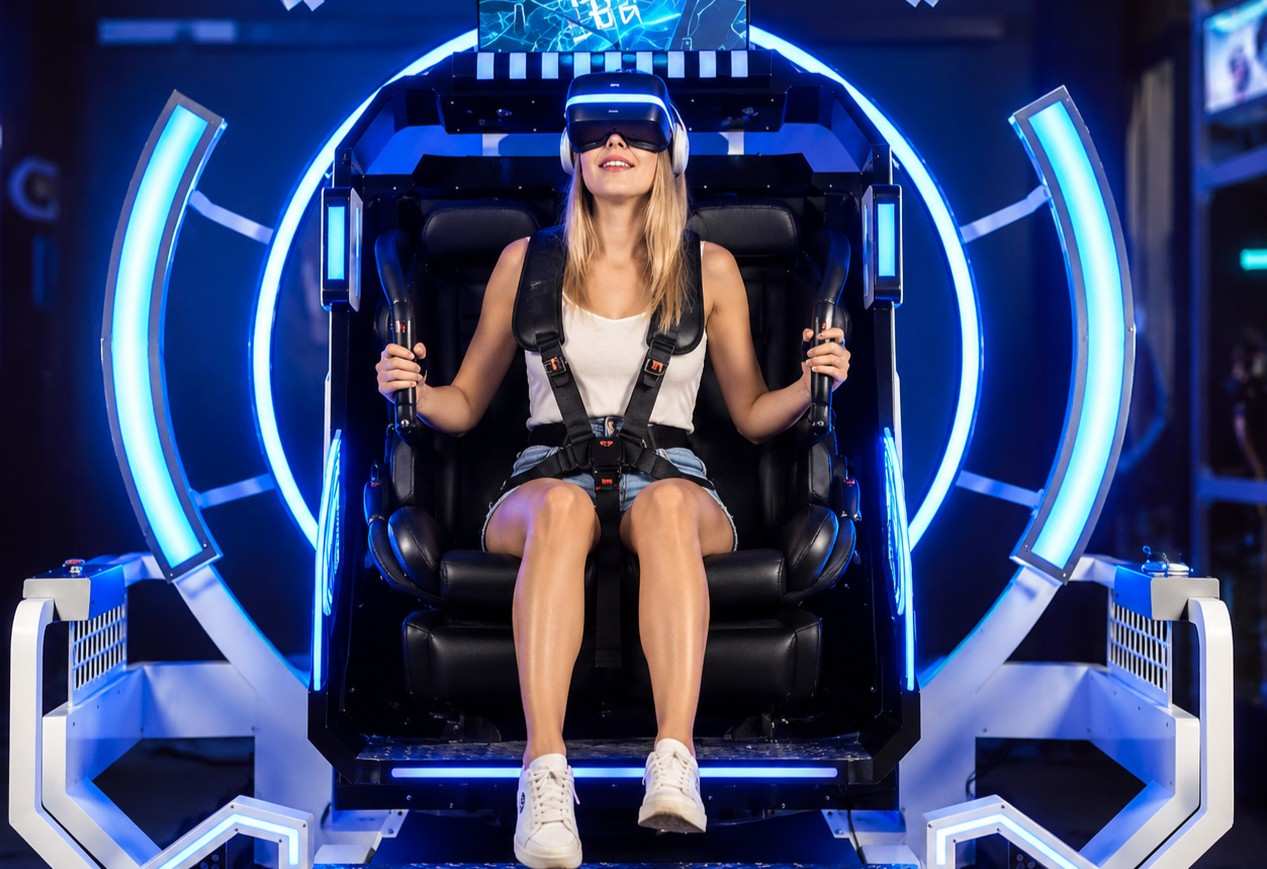
Virtual reality gaming centers are moving beyond headsets and screens. Today’s players increasingly expect to see, hear, and physically feel what happens inside a virtual environment. That is where 360 VR chairs are becoming an important part of the commercial VR experience.
A 360 VR chair combines a VR headset with physical movement such as rotation, tilting, vibration, and other effects. Depending on the model, the chair can synchronize these movements with the virtual content, making a roller coaster feel like it is turning, a flight simulation feel more dynamic, or an action game feel more physically engaging. Commercial VR equipment manufacturers already offer 360-degree motion chairs designed specifically for arcades, shopping malls, family entertainment centers, and VR venues.
The bigger change is not simply the chair itself. It is how VR motion technology is changing the way gaming centers design attractions, manage space, and create memorable experiences.
What Is a 360 VR Chair?
A 360 VR chair is a motion-enabled seating system designed to work with virtual reality content.
The headset provides the visual immersion. The chair adds physical movement.
Depending on the equipment, motion can include:
● 360-degree rotation
● Forward and backward movement
● Tilting
● Vibration
● Seat or body effects
● Wind or environmental effects
● Controller interaction
● Motion synchronized with VR content
Some commercial systems combine several of these features. For example, current VR chair products advertise full rotation, motion simulation, vibration, wind effects, VR headsets, and interactive games as part of the same attraction.
That combination creates an experience that is different from simply standing or sitting in front of a conventional gaming screen.
Why VR Gaming Centers Are Adding Motion
A standard VR headset already creates visual immersion. But visual movement and physical stillness can sometimes feel disconnected.
A motion chair attempts to reduce that gap by giving the player’s body corresponding physical cues.
Imagine a virtual roller coaster.
On a normal screen, you see the track moving.
With a VR headset, you see the track from the rider’s perspective.
With a VR 360 simulator, the chair can also rotate or tilt while the virtual ride changes direction.
That doesn’t make the virtual movement physically identical to a real roller coaster, but it adds another sensory layer to the experience.
This is one reason motion-based attractions can work particularly well in commercial entertainment environments: the hardware itself becomes part of the attraction.
How Motion Synchronization Works
The most important element isn’t simply how far a chair can rotate. It is how accurately the physical movement corresponds to what the player sees.
This is known as motion synchronization.
A VR system generally has several components working together:
VR headset:
Displays the virtual environment and tracks head movement.
Game or video content: Determines what the user sees and when virtual events occur.
Motion controller: Translates instructions from the software into physical movement.
Chair or motion platform: Performs rotation, tilting, vibration, or other effects.
Additional effects: Some commercial systems add wind, sound, lighting, or other sensory effects.
The goal is to make these elements feel coordinated rather than separate.
If a virtual vehicle turns left while the chair responds at the appropriate moment, the experience can feel more convincing. If the physical movement happens too early, too late, or too aggressively, immersion can suffer.
360 VR Chairs Create a Different Kind of Immersion
Traditional arcade machines depend heavily on screens, controls, sound, and physical interaction.
VR changes the visual relationship between the player and the game.
A motion chair adds another layer.
Instead of simply controlling a virtual vehicle, for example, the player can sit inside a physical simulator while seeing a virtual environment through a headset.
This is particularly useful for experiences such as:
● Roller coaster simulations
● Flight experiences
● Racing
● Space adventures
● Horror experiences
● Shooting games
● Fantasy rides
● Exploration
● Interactive cinematic content
Commercial manufacturers currently market 360 VR motion chairs for arcade venues and entertainment centers with content ranging from roller-coaster-style experiences to interactive games.
Why Motion Matters in VR Entertainment
Immersion isn’t created by visuals alone.
The brain combines information from multiple sensory systems when interpreting movement and orientation. Research on cybersickness describes how visual motion can conflict with signals from the vestibular and proprioceptive systems when the person sees movement without physically experiencing the same movement. Research on cybersickness and sensory integration.
That makes physical motion an interesting part of VR design.
However, this doesn’t mean that adding movement automatically eliminates discomfort. VR experiences can still produce cybersickness, and the effect varies between people and experiences.
A 2025 systematic review found that discomfort associated with fully immersive VR can include oculomotor symptoms and disorientation, while another systematic review found that VR-related adverse effects can include nausea and disorientation. 2025 systematic review of VR cybersickness and discomfort.
For gaming centers, that makes thoughtful motion design more important than simply making a chair move as much as possible.
How 360 VR Chairs Change the Gaming Center Experience
The biggest transformation happens at the venue level.
A conventional gaming center might compete through the number of games available. A modern VR entertainment center can instead compete through the quality of the physical experience.
A well-designed motion attraction can become something customers specifically remember.
1. More Memorable Experiences
A customer may forget the details of an ordinary arcade game after leaving.
A VR experience involving movement, sound, visuals, and physical effects can be more distinctive because several senses are involved simultaneously.
That can make motion-based attractions useful as headline experiences inside entertainment centers.
2. More Variety From One Hardware Platform
A single motion chair can potentially support different types of VR content.
One session could be a roller coaster. Another could be a flight experience. A third could be an interactive action game.
The exact content library depends on the hardware and software ecosystem, but this flexibility can make motion equipment more useful than a single-purpose ride.
3. Strong Visual Appeal
A 360 VR chair can also attract attention before someone even tries it.
Large motion platforms, enclosed cabins, illuminated structures, headsets, and moving seats naturally stand out in a busy arcade environment.
That matters because entertainment centers are physical spaces where customers often decide what to try by looking at the attractions around them.
360 VR Chairs vs. Traditional VR Stations
Not every gaming center needs a motion chair.
A traditional VR station may be more appropriate when the priority is free movement, multiplayer interaction, or a large library of room-scale experiences.
A motion chair is more attractive when the venue wants:
● A compact attraction
● Seated VR gameplay
● Strong physical effects
● Short immersive sessions
● Simulator-style experiences
● A visually distinctive machine
The right choice depends on the venue’s floor plan, audience, content, staffing, and operating model.
A Simple Comparison
| Feature | Traditional VR Station | 360 VR Chair |
| Visual immersion | High | High |
| Physical motion | Limited or none | High |
| Seated experience | Optional | Core feature |
| Free movement | Often available | Usually limited |
| Simulator-style content | Possible | Strong fit |
| Physical footprint | Varies | Varies by model |
| Attraction visibility | Moderate | Often high |
| Best suited to | Interactive VR | Motion-based VR experiences |
The important point is that neither system is universally better. They serve different experiences.
What Gaming Center Owners Should Evaluate
If you’re considering VR arcade equipment, don’t choose a chair simply because it rotates 360 degrees.
Look at the complete system.
Motion Range
Understand exactly what the machine can do.
Does it rotate? Tilt? Vibrate? Combine multiple axes? The phrase “360 VR” alone doesn’t tell you how sophisticated the motion system is.
Content Compatibility
A powerful chair is only useful if it has content people want to play.
Check:
● Number of supported experiences
● Content licensing
● Update process
● Game compatibility
● Language options
● Multiplayer support
● Session management
Space Requirements
Commercial motion equipment can be substantially larger and heavier than ordinary gaming seats.
One current commercial 360 VR chair listing, for example, specifies a footprint of approximately 2.3 by 1.3 metres and a net weight of 436 kg. Specifications vary considerably between manufacturers and models, so venue operators should use the exact manufacturer’s installation drawings rather than assuming all chairs have similar dimensions.
Maintenance
Moving hardware has more mechanical components than a stationary gaming setup.
Ask about:
● Spare parts
● Preventive maintenance
● Software updates
● Technical support
● Warranty coverage
● Installation
● Calibration
● Emergency servicing
For a commercial venue, downtime can matter just as much as the initial purchase price.
Safety and User Comfort Matter
More motion does not necessarily mean a better experience.
Operators need to consider user comfort, restraint systems, loading and unloading, equipment maintenance, and staff supervision.
VR-related discomfort can include nausea, disorientation, and eye-related symptoms. A systematic review of VR sickness found that content, visual stimulation, locomotion, and exposure time can all influence reported symptoms.
That means gaming centers should avoid treating motion as a simple “more is better” feature.
A better approach is controlled, synchronized movement that matches the experience and is appropriate for the equipment.
Staff should also know how to stop an experience quickly if a customer feels unwell.
Where 360 VR Chairs Fit Best
The strongest use cases are places where customers are specifically looking for immersive entertainment rather than long-form gaming sessions.
These can include:
Shopping Malls
A motion attraction can work as a visually prominent entertainment feature in a high-footfall environment.
Family Entertainment Centers
VR chairs can sit alongside arcade games, racing simulators, soft-play attractions, and other activities.
Dedicated VR Arcades
A dedicated VR venue can use motion chairs as one part of a broader library of immersive experiences.
Tourist Attractions
Short, visually impressive VR experiences can work well where visitors are looking for something memorable without committing to a long gaming session.
Events and Entertainment Zones
Portable or modular VR equipment can also be considered for temporary entertainment environments, depending on the manufacturer’s installation requirements.
Are 360 VR Chairs the Future of VR Gaming Centers?
They are unlikely to replace every type of VR station.
Instead, they represent one direction in the broader evolution of immersive VR entertainment.
The most successful gaming centers may combine different technologies rather than relying on one machine type.
A venue could have free-roaming VR for multiplayer experiences, racing simulators for competitive play, motion chairs for cinematic attractions, and conventional arcade machines for casual gaming.
That variety gives customers a reason to return.
The real opportunity isn’t simply putting a VR headset on a moving chair. It is creating a venue where different technologies work together to deliver experiences that a customer cannot easily reproduce at home.
Final Thoughts
360 VR chairs are changing virtual reality gaming centers by adding physical movement to visual immersion.
Their value comes from the combination of VR content, motion synchronization, physical effects, and venue design. When those elements work together, a gaming center can offer experiences that feel more like attractions than conventional video games.
But choosing the right equipment requires more than looking at rotation angles or impressive specifications. Operators should evaluate content, space, maintenance, safety, comfort, technical support, and the type of audience they want to attract.
The future of VR arcades may not be about choosing between gaming and amusement rides.
It may be about combining the two.