Gaming stopped being a niche hobby a long time ago, and the numbers make that hard to argue with. According to the Entertainment Software Association’s 2026 Essential Facts report, 67% of Americans now play video games at least an hour a week, and the average player is 37 years old, not the teenager most people still picture. Globally, the industry generates somewhere around $200 billion a year in software revenue alone, which puts it ahead of the film and recorded music industries combined.
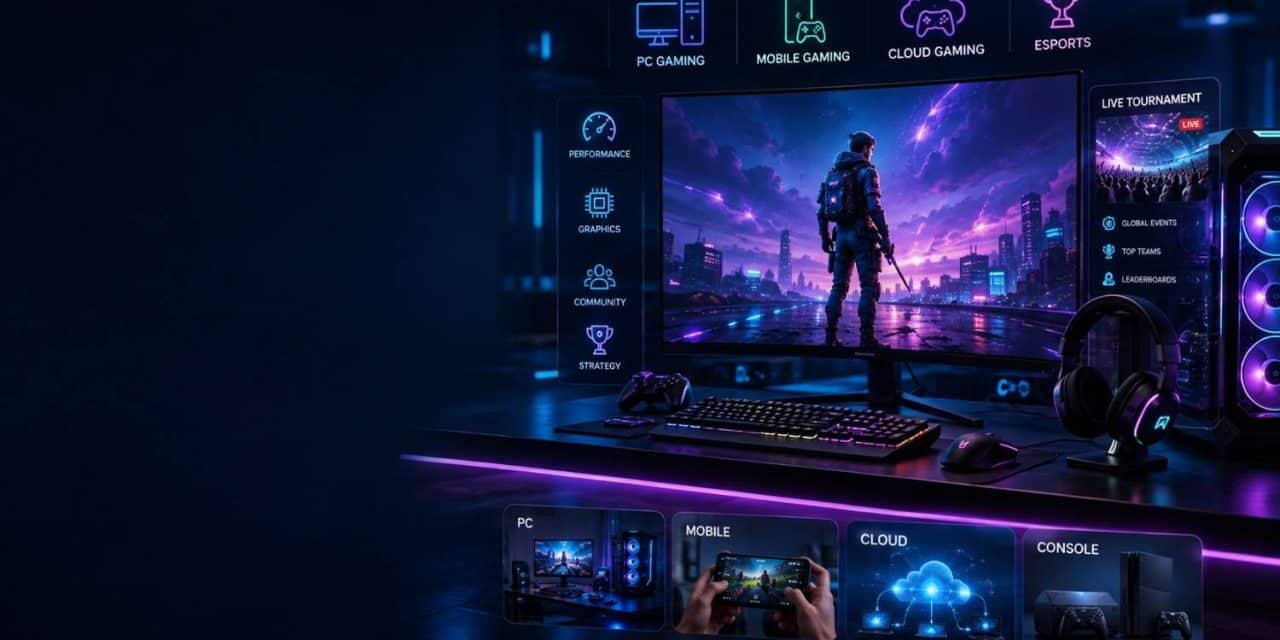
What’s changed more than the size of the audience is how fragmented “gaming” has become as a category. PC, mobile, console, cloud, and competitive esports each have their own economics, their own hardware requirements, and their own communities, and treating them as one blob makes it harder to actually find what you’re looking for, whether that’s a new game, a laptop, or a way to understand where the industry is heading. This guide breaks the landscape down platform by platform, with real 2026 data throughout instead of the recycled “gaming is booming” statistics that circulate every year regardless of whether they’re still accurate.
How Big Is Gaming, Actually, in 2026?
Market size estimates vary more than you’d expect for an industry this large, mostly because research firms disagree on what to count (hardware, advertising, in-game purchases, subscriptions all get treated differently). A few figures that show up consistently across sources:
- Global games software revenue sits in the $200 to $210 billion range for 2026, according to multiple market trackers including Newzoo, whose 2026 PC & Console Gaming Report tracks the split between platforms in detail.
- U.S. consumer spending alone hit $60.7 billion in 2025, per the ESA, supporting more than 250,000 jobs and $95.8 billion in total U.S. economic impact.
- Mobile remains the largest platform by revenue, holding roughly half the market, with console and PC splitting most of the rest.
- The global player base is estimated at around 3.6 billion people, close to 44% of everyone alive.
The honest caveat: treat any single-decimal-point figure you see in a headline with some skepticism. Different firms count differently, and the gap between the lowest and highest published estimates for the same year can run into the tens of billions.
PC Gaming: Still the Enthusiast’s Platform
PC gaming has settled into a stable, if slower-growing, role in the industry: fewer total players than mobile, but the highest spend per player and the deepest ecosystem of genres, mods, and communities.
Choosing Hardware That Actually Matters
The single most reliable dataset on what PC gamers actually run is Valve’s own Steam Hardware & Software Survey, updated monthly from millions of opted-in machines. It’s a genuinely useful reality check before buying anything, since it shows what the median gaming PC looks like rather than what a manufacturer’s marketing page implies you need.
If you’re building or upgrading, the processor question trips up more people than it should, mostly because clock speed gets oversold relative to core count and cache size for gaming workloads specifically. Our breakdown of how to choose a gaming CPU walks through what actually affects frame rates versus what’s mostly marketing.
Laptops are a different calculation entirely, since thermal limits change the performance picture compared to desktop parts with the same name. Our guide to spotting high-performing gaming laptops covers the specs worth checking versus the ones that mostly pad a spec sheet. If you’re shopping specifically in India, our roundup of gaming laptops under ₹70,000 covers what’s realistic at that price point without the inflated claims common in that segment.
On the display side, a monitor upgrade often improves the actual feel of a game more than a GPU upgrade would, particularly for competitive titles. Our comparison of the best gaming monitors for PS4 Pro is console-focused but the underlying panel and refresh-rate guidance carries over to PC setups aimed at similar resolutions.
PC Genres Worth Knowing
Shooters remain PC gaming’s most consistently popular competitive genre, and the Call of Duty franchise is one of the clearest examples of how a series stays relevant across a decade of releases. Our piece on Call of Duty: Modern Warfare covers what set that entry apart from the rest of the series.
Open-world games built their modern template largely around the Grand Theft Auto series, and understanding why that franchise keeps dominating sales charts says a lot about what open-world design actually needs to succeed. We cover that directly in what makes GTA games so popular.
Platformers never went away, they just moved to indie studios after the big publishers mostly abandoned the genre. If that’s your interest, our list of games similar to Crash Bandicoot covers where the genre’s spirit lives on today.
Sandbox and survival games are effectively their own economy at this point, and Minecraft remains the clearest example. If you’re running or joining a community server, our Minecraft server list guide walks through what to look for beyond just player count.
Mobile Gaming: The Platform Most People Actually Use
Mobile isn’t just the biggest gaming platform by revenue, it’s the one most people’s first gaming experience happens on today, largely because it requires no dedicated hardware purchase at all. MOBAs (multiplayer online battle arenas) are one of mobile’s biggest competitive genres, and titles built specifically for touchscreen controls, like Mobile Legends, have built enormous player bases that PC-first MOBAs never fully replicated on phones. Our guide on how to play as Lolita in Mobile Legends is a good example of the kind of character-specific depth that keeps mobile esports communities engaged season after season.
The gap between mobile and PC/console gaming has narrowed on the technical side faster than most people realize; current flagship phones can run graphically demanding titles that would have needed a dedicated gaming PC a decade ago. What hasn’t narrowed as much is monetization: mobile remains far more dependent on in-app purchases and free-to-play models than PC or console, which shapes game design decisions in ways that are easy to miss if you only play on one platform.
Cloud Gaming: Smaller Than the Hype, Still Growing Fast
Cloud gaming, streaming a game from a remote server to a phone, TV, or underpowered laptop, gets talked about as the industry’s next big shift, and the growth rate backs that up even though the absolute numbers stay modest for now. Mordor Intelligence’s cloud gaming market analysis puts the segment at roughly $6 billion in 2026, growing at a compound annual rate above 25%, though other firms estimate the market anywhere from $5 billion to over $20 billion depending on what they count as “cloud gaming” revenue.
What’s consistent across every estimate is the direction: falling latency thanks to 5G and edge computing, expanding platform availability (Xbox Cloud Gaming and PlayStation’s streaming options have both added new regions in the past year), and a growing willingness among casual players specifically to trade ownership of hardware for access through a subscription.
Virtual reality sits adjacent to this shift, and it’s had its own uneven growth curve, real but slower than early predictions suggested. Beyond the headset itself, the physical setup around VR gaming has become a small industry of its own. Our look at how 360-degree VR chairs are transforming virtual reality gaming centers covers the location-based side of VR, which has grown into a meaningfully different business from home VR headset sales.
Esports: A Real Industry With Wildly Inconsistent Numbers
If there’s one part of the gaming industry where published statistics genuinely contradict each other, it’s esports. Depending on the source, global esports revenue for 2026 gets estimated anywhere from under $2 billion to more than $5 billion, and some longer-range forecasts go considerably higher still. The disagreement mostly comes down to what counts as esports revenue: some trackers include only sponsorships, media rights, and ticket sales, while others fold in the much larger mobile esports and betting-adjacent categories.
What’s not in dispute is that competitive gaming has built a genuine media and events business around it. Prize pools at major tournaments now regularly exceed those of many traditional sporting events, sponsorship deals with mainstream brands have become routine rather than novel, and more than 280 U.S. colleges now offer varsity esports programs with scholarships attached, according to the ESA’s most recent data.
Esports also underlines something true of the wider gaming industry: the biggest audiences aren’t always where the biggest prize pools are. Mobile esports titles draw enormous viewership in Southeast Asia, Latin America, and India, regions that get far less Western media coverage than the PC-based tournaments most gaming press focuses on.
Gaming as a Social and Cultural Activity
A meaningful share of gaming today isn’t really about the game itself, it’s about the people you’re playing with. Co-op and party games built specifically around shared screens or shared sessions have had a real resurgence, partly as a reaction to how solitary a lot of competitive gaming became during the pandemic years. If you’re looking for something to play with a group rather than against strangers, our roundup of the best online games to play with friends covers options across skill levels and group sizes.
That social pull is also a big part of why gaming keeps getting described as an entertainment category rather than just a hobby. Our piece on how online gaming drives the entertainment revolution covers the broader shift, streaming, watch parties, community events, that’s pulled gaming into the same cultural space as television and live sports.
Play-to-Earn and Making Money Through Games
A smaller but persistent corner of the industry lets players earn real money through gameplay, whether through tournament winnings, streaming revenue, in-game item trading, or dedicated play-to-earn titles. It’s a genre that attracted a lot of hype and a fair amount of scams in equal measure over the past few years, so approaching it with real caution matters. Our guide to playing games with earnings covers the legitimate paths into this space and the red flags worth watching for before committing time or money to any platform that promises guaranteed income.
Gaming’s Legacy Genres Haven’t Gone Anywhere
For every trend chasing the newest hardware, there’s an equally large audience still playing games that predate most of the current industry’s business models entirely.
Arcade classics built the template competitive gaming still runs on, and revisiting them is more than nostalgia; it’s a look at design decisions that still influence modern game balance. Our piece on Pac-Man’s 30th anniversary covers why a game that simple still gets studied by designers decades later.
Strategy board games made the jump to digital formats without losing their core audience, and titles like Reversi (Othello) remain genuinely popular in app form. Our guide on Reversi/Othello strategy covers the fundamentals for anyone coming to it fresh.
Prediction and simulation games occupy an interesting psychological niche: they’re popular specifically because they let players test decisions against an outcome without real-world consequences. We cover that appeal directly in why people love future-predicting games, a genre that spans everything from simple prediction apps to complex simulation titles.
Casual browser and mobile-web games never disappeared either, they just moved to a less visible corner of the internet. Titles like Moto X3M keep drawing steady traffic precisely because they require no download and no commitment. Our page on playing Moto X3M across mobile, desktop, and tablet covers where to find it running reliably.
Gaming, Kids, and Access at School or Work
Video games get an unfairly one-sided reputation in a lot of parenting and workplace conversations, and the research doesn’t support the blanket “games are just a distraction” framing. Our piece on what children can learn from video games covers the genuine cognitive and social benefits documented in developmental research, alongside honest guidance on the limits and the importance of moderation.
A related, more practical topic: many schools and workplaces block gaming sites on their networks, which pushed an entire category of “unblocked games” into existence, browser-based titles hosted specifically to work around network filters. Our guide to Tyrone’s Unblocked Games covers one of the more established hubs in that space, and our companion piece on unblocked games for brain development and stress relief covers the legitimate case for short gaming breaks during a school or work day, distinct from the “games are just a distraction” framing.
Why Some Games Cross Borders and Others Don’t
One of the less-discussed factors behind which games become global hits versus regional successes is localization quality, and it goes well beyond simple text translation. Voice acting, cultural references, humor, and even color choices tied to regional meaning all affect whether a game lands with an international audience. Our piece on the role of translations in turning local games into global success stories covers case studies of titles that got this right, and the ones that didn’t.
A Practical Framework for Picking Your Next Platform
If you’re deciding where to put your time or money next, a few honest tradeoffs are worth weighing rather than defaulting to whatever platform is loudest in gaming media right now:
- PC gives you the widest genre selection, the best modding and customization ecosystem, and the highest upfront hardware cost.
- Console trades some flexibility for a simpler, more predictable experience and generally the best price-to-performance ratio for graphically demanding games.
- Mobile requires no additional hardware purchase at all and dominates casual and free-to-play genres, but monetization models can make some titles expensive over time in ways that aren’t obvious upfront.
- Cloud gaming removes the hardware requirement almost entirely, at the cost of needing consistently strong internet and accepting that not every title is available on every service yet.
Most serious players end up using more than one of these rather than picking a single platform permanently, and that’s a reasonable default rather than a compromise.
How Games Actually Make Money in 2026
Understanding monetization models explains a lot about why certain games feel the way they do, and why the same franchise can feel completely different depending on which platform you play it on.
Premium (pay-once) remains the standard for big-budget PC and console releases, though it’s increasingly paired with expansions and cosmetic add-ons rather than standing entirely alone the way it did a decade ago.
Free-to-play with microtransactions dominates mobile and has a growing footprint on PC and console too, particularly in competitive multiplayer genres. The ESA’s research found that a majority of Gen Alpha, Gen Z, and Millennial players have purchased in-game content, typically spending around $20 a month, which shows how normalized this model has become across age groups rather than being isolated to any one demographic.
Subscription services, bundling access to a rotating library of games for a flat monthly fee, have grown from a niche offering into a mainstream option, especially paired with cloud gaming access. The appeal is straightforward: lower risk per game tried, at the cost of losing access if you cancel.
Games-as-a-service blurs premium and free-to-play by charging upfront but layering ongoing content drops, seasonal events, and battle passes on top. This model has become the default for most major competitive multiplayer titles because it keeps players and revenue flowing well past a game’s launch window.
None of these models is inherently better than the others; they suit different kinds of games and different player habits. The practical takeaway is to notice which model a game uses before committing time to it, since a free-to-play competitive title and a premium single-player game ask for very different kinds of ongoing investment.
Genres Beyond the Big Three
PC and console coverage tends to focus heavily on shooters, open-world games, and sports titles, but several other genres have quietly built massive, dedicated audiences.
Role-playing games (RPGs) remain one of the most durable genres in the industry precisely because they reward long-term investment, both narratively and mechanically, in a way few other genres attempt. Whether turn-based, action-based, or massively multiplayer, RPGs tend to have the highest average playtime per title of any major genre.
Strategy games, both real-time and turn-based, have a smaller but famously dedicated player base, and the genre has aged unusually well compared to others because deep strategic depth doesn’t go stale the way visual fidelity does.
Sports and racing simulations occupy a middle ground between mainstream accessibility and genuine simulation depth, and they’re one of the few genres where the yearly-release model still works, largely because roster updates and rules changes genuinely matter to the core audience.
Puzzle and casual games are mobile’s biggest single category by download volume, even if they don’t generate headlines the way competitive titles do. Their low barrier to entry is exactly why they’re often the entry point that turns a non-gamer into a regular player.
Horror and narrative-driven indie games have thrived specifically because smaller budgets let developers take creative risks that big-budget studios generally can’t justify to investors, which is part of why some of the most talked-about games of the past few years have come from teams of a dozen people or fewer rather than major publishers.
Streaming, Content Creation, and the Gaming Media Ecosystem
Watching games has become nearly as large a cultural activity as playing them. Platforms built around game streaming, Twitch, YouTube Gaming, and a growing number of mobile-first alternatives popular in Asia, have created an entire creator economy layered on top of the games themselves. A meaningful share of a modern game’s marketing now happens through streamers and content creators rather than traditional advertising, which has shifted how publishers think about launch strategy: getting the right creators playing a game in its first week often matters more than a traditional ad campaign.
This shift has also changed player expectations. Games are increasingly designed with “watchability,” memorable moments, clear visual readability, built in from the start, because a title that plays well but streams poorly loses a meaningful growth channel that didn’t exist for the industry twenty years ago.
Peripherals and Accessories Worth Understanding
Beyond the core PC or console itself, a growing accessory market has become genuinely relevant to the actual gaming experience rather than being pure add-on spending.
Controllers and input devices matter more than most casual buyers assume: a mismatched controller can bottleneck performance in competitive genres as much as a weaker processor would. Mice with adjustable weight and polling rate, mechanical keyboards with consistent actuation points, and controllers with remappable buttons all show measurable competitive benefits in genres where reaction time matters.
Audio is the most underrated upgrade in the entire hardware conversation. Positional audio cues, footsteps, gunfire direction, matter enormously in competitive shooters specifically, and a mediocre headset can cost more in-game awareness than a GPU upgrade would gain.
Chairs, desks, and general ergonomic setup rarely get serious coverage compared to the components inside the machine, but they matter enormously for anyone playing multiple hours a day, both for comfort and for avoiding the repetitive strain injuries that are increasingly common among both casual and competitive players.
Regional Gaming Markets Look Very Different From Each Other
Treating “the gaming market” as one global monolith hides some real differences worth knowing if you’re trying to understand where the industry is actually headed.
Asia-Pacific holds the largest single share of global gaming revenue, driven heavily by mobile gaming’s dominance in China, Japan, South Korea, and increasingly Southeast Asia, where smartphone-first internet access made mobile the default gaming platform rather than a secondary one.
North America generates outsized revenue relative to its player count, reflecting both higher average spend per player and console and PC gaming’s continued strength compared to other regions.
India and parts of the Middle East and Africa represent the fastest-growing player bases globally, even though revenue per player remains comparatively low, largely a function of affordability rather than engagement; time-spent-in-game metrics in these regions are often as high as anywhere else.
Europe sits in a middle position on most metrics, with PC gaming holding a notably stronger share than in North America, partly a legacy of the region’s earlier PC gaming culture before consoles became dominant elsewhere.
Understanding these regional differences matters for anyone trying to make sense of industry news, a headline about “declining engagement” or “surging growth” often only applies to one region or platform, not the industry as a whole.
Common Mistakes When Buying Gaming Hardware
A handful of avoidable mistakes show up repeatedly among people upgrading or building a gaming setup for the first time:
- Bottlenecking a strong GPU with a weak CPU, or the reverse, spending most of the budget on one component while leaving the other under-powered undermines the whole build’s actual performance.
- Chasing benchmark numbers that don’t match your actual games. A processor that wins synthetic benchmarks isn’t automatically the best choice if the games you actually play are GPU-bound rather than CPU-bound.
- Ignoring the display entirely. A high-end PC paired with a low refresh-rate monitor wastes a meaningful share of that investment, particularly in competitive genres where frame rate directly affects playability.
- Underestimating storage needs. Modern AAA titles routinely exceed 100GB installed, and load-time differences between older and newer storage technology are large enough to notice in daily use.
- Buying for hypothetical future-proofing instead of current needs. Hardware depreciates fast enough that paying a premium for headroom you won’t use for two or three years rarely pays off compared to upgrading again later.
Gaming, Screen Time, and Wellbeing
The conversation around gaming and mental health has matured considerably from the moral-panic framing common a decade or two ago, and it’s worth separating what the research actually supports from what’s just repeated assumption.
Moderate gaming is generally associated with stress relief and social connection rather than harm, particularly for multiplayer and cooperative genres that involve real interaction with other people rather than isolated play. Several studies on veterans and older adults specifically have found measurable benefits in stress management and cognitive engagement from regular, moderate play.
Where the research does show genuine concern is around excessive, compulsive play that displaces sleep, in-person relationships, or other responsibilities, patterns that mental health professionals increasingly discuss using the same behavioral framework applied to other compulsive activities. The distinction that matters isn’t hours played in isolation, it’s whether gaming is displacing things a person values or needs, which is a much more individual question than any blanket screen-time number can answer.
For parents specifically, content rating systems (ESRB in North America, PEGI in Europe) remain the single most useful practical tool, since they’re designed specifically to flag violence, language, and other content by age appropriateness, and they’re far more reliable than trying to judge a game by its marketing or box art alone.
The Business Side: Consolidation and Studio Trends
The past several years have seen significant consolidation among game publishers and studios, with major acquisitions reshaping which companies control which franchises. This has real consequences for players beyond just corporate ownership charts: consolidation can mean more resources behind a favorite franchise, but it can also mean studio closures, canceled projects, and the loss of smaller developers’ distinct creative voices when they get absorbed into larger publishing structures.
Independent development, meanwhile, has never been more accessible from a tools standpoint. Engines like Unity and Unreal are freely available, and digital storefronts have removed most of the old distribution barriers that once required a publisher relationship just to reach players. The result is a genuinely bifurcated industry: a smaller number of very large studios producing fewer, bigger-budget releases, alongside a much larger and more active independent scene than existed a decade ago. Some of the most critically acclaimed and commercially successful titles of the past few years have come from teams that would have struggled to get funded by a traditional publisher at all.
Frequently Asked Questions
Is PC gaming or console gaming better in 2026? Neither is objectively better; the honest answer depends on priorities. PC offers more flexibility, better long-term value through backward compatibility and mod support, and higher upfront cost. Console offers simplicity, generally lower entry cost, and a more consistent performance experience across every game in the library.
How big is the mobile gaming market compared to PC and console combined? Mobile holds roughly half of global games software revenue, putting it ahead of PC and console combined by most market trackers’ estimates, even though PC and console still lead in spend per player.
Is cloud gaming actually good enough to replace a console or PC? For casual and moderately competitive play with a strong, stable internet connection, cloud gaming has become genuinely usable. For fast-paced competitive esports titles where milliseconds matter, local hardware still has a real, measurable latency advantage.
Why do esports revenue statistics vary so much between sources? Different research firms define esports revenue differently, some count only sponsorships, media rights, and ticketing, while others include the much larger mobile esports and adjacent betting markets. There’s no single industry-standard definition yet, which is why headline numbers can differ by billions of dollars for the same year.
Are video games actually good for kids, or just a distraction? Research generally points to a more nuanced picture than either extreme: age-appropriate games in moderation are linked to benefits in problem-solving, coordination, and social connection, while excessive, unmoderated play or inappropriate content for the child’s age carries real downsides. Content rating and time limits matter more than the blanket question of whether games are “good” or “bad.”
What’s the single most useful thing to check before buying gaming hardware? Cross-reference specs against a real usage dataset like the Steam Hardware Survey rather than manufacturer marketing claims alone, and prioritize the component that actually bottlenecks your specific games (often the GPU for visual fidelity, the CPU for simulation-heavy or strategy titles).
Do I need a gaming PC or console to get into esports, or can I start on mobile? Mobile esports is a legitimate, large-scale competitive scene in its own right, not a lesser version of PC or console esports. Titles built specifically for mobile draw viewership numbers that rival PC-based tournaments in several regions, particularly across Southeast Asia and Latin America, so starting on mobile is a genuinely viable path rather than a compromise.
How much should a beginner expect to spend to get a decent gaming setup? It depends heavily on platform: a capable current-generation console runs a few hundred dollars with no additional hardware needed, while a solidly performing gaming PC typically starts noticeably higher once a monitor, peripherals, and a reasonable GPU are factored in. Mobile gaming, by contrast, often needs no dedicated purchase at all beyond a phone most people already own.
A Quick Checklist Before You Commit to a Platform or Purchase
- Have you checked what games or genres you actually want to play, rather than starting from the hardware and working backward?
- If buying PC hardware, have you compared your planned build against real-world data like the Steam Hardware Survey rather than a single retailer’s recommended specs?
- If considering cloud gaming, have you tested your actual internet connection’s stability, not just its advertised speed, during peak hours?
- If the purchase is for a child, have you checked the content rating (ESRB or PEGI) against what’s actually appropriate for their age, rather than relying on box art or a friend’s recommendation?
- Are you choosing a platform based on what you’ll realistically use most, rather than the one that gets the most attention in gaming media this month?
That last point is worth sitting with. A large share of gaming purchases and platform switches are driven by hype cycles around a single high-profile release rather than an honest look at ongoing usage patterns, and those are the purchases most likely to go underused within a year.
Where to Go From Here
Gaming in 2026 isn’t one industry so much as several overlapping ones sharing a name, and the platform that’s “best” depends entirely on what you’re actually trying to get out of it: competitive depth, social connection, casual downtime, or something to build a hobby or even a side income around. If you want to keep exploring, our full gaming coverage hub is organized by platform and genre rather than publish date, which makes it easier to find what’s actually relevant to the platform you’re on.