



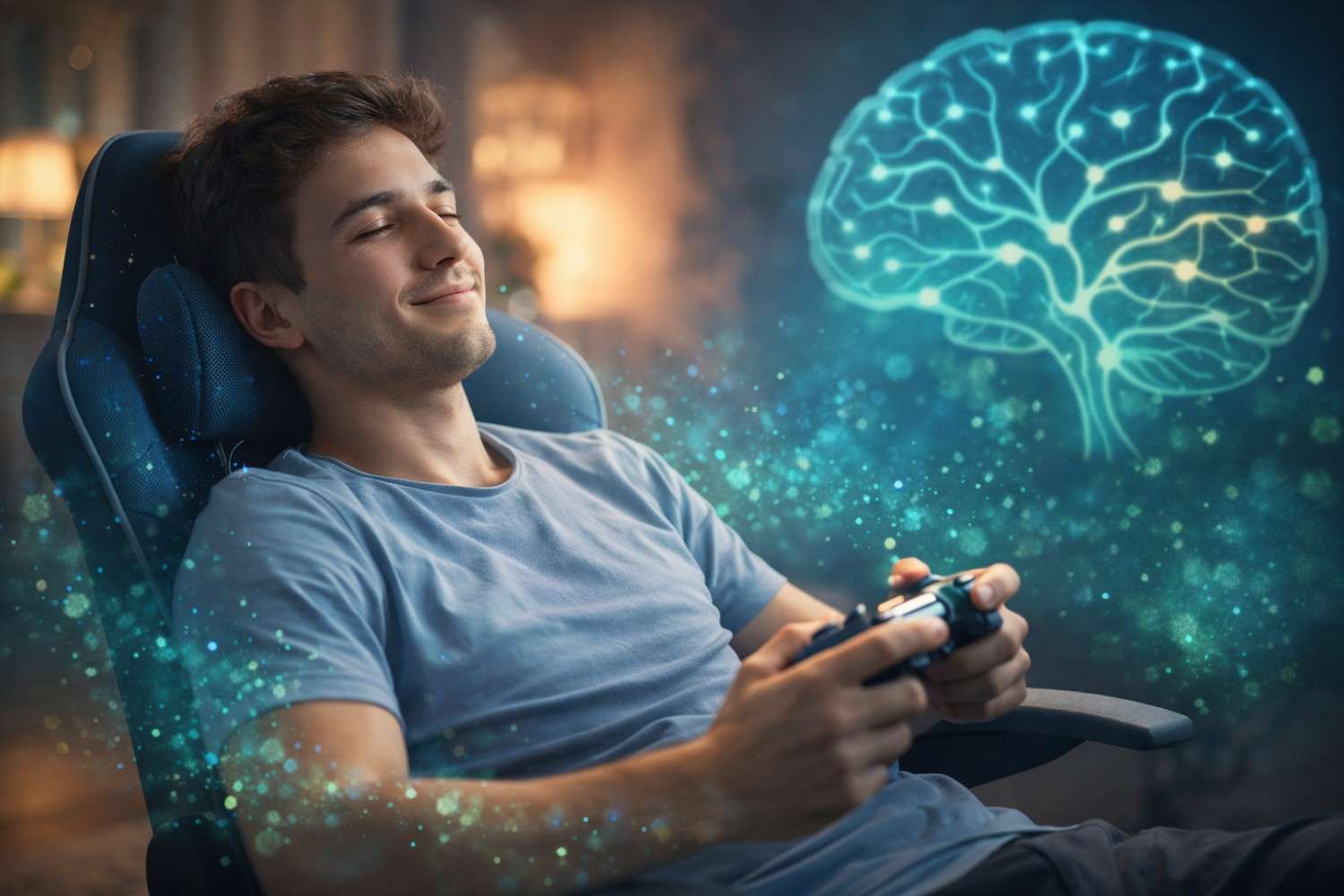
I’ll be honest with you—when I tell people I spend a good chunk of my free time gaming, I still get those looks. You know the ones. The slightly concerned expression that says, “Isn’t that just wasting time?” But here’s what most people don’t realize: that controller in your hand or those keys under your fingers aren’t just tools for entertainment. They’re instruments for cognitive enhancement and stress relief that would make any neuroscientist sit up and take notice.
Let me take you on a journey through the fascinating world of how gaming actually works on your brain, backed by science, real experiences, and some surprising discoveries that might just change how you think about those hours spent in virtual worlds.
The Brain-Gaming Connection: What’s Really Happening Up There?
When you’re navigating through a complex puzzle in Portal or coordinating a team strategy in Overwatch, your brain isn’t just passively receiving information—it’s lighting up like a Christmas tree. Multiple regions are firing simultaneously, creating neural pathways and strengthening existing connections in ways that traditional “brain training” apps could only dream of achieving.
Research from the University of California, Irvine found that participants who played 3D video games for 30 minutes daily over two weeks showed improvements in hippocampal-associated memory. That’s the part of your brain responsible for converting short-term memories into long-term ones. Think about that for a second—the same activity people dismiss as mindless entertainment is actually enhancing one of your brain’s most critical functions.
But it goes deeper than just memory. A study published in the journal Nature demonstrated that action game players showed improved visual attention and spatial cognition compared to non-gamers. They could track more objects simultaneously, process visual information faster, and make quicker decisions under pressure. These aren’t trivial skills—they translate directly into real-world applications, from driving in heavy traffic to performing surgery.
Cognitive Skills That Level Up Through Gaming
Problem-Solving and Critical Thinking
Every game, at its core, is a series of problems waiting to be solved. Whether you’re figuring out the optimal build order in a strategy game or deciphering environmental clues in a mystery adventure, you’re constantly exercising your problem-solving muscles.
Take puzzle games like Quordle, for instance. These word-based challenges require pattern recognition, vocabulary recall, and strategic thinking—all while racing against the clock. You’re not just playing; you’re training your brain to approach problems from multiple angles, test hypotheses, and adapt when your initial strategy fails.
The beauty of gaming as a problem-solving tool is its immediate feedback loop. Make a wrong move, and you see the consequences right away. This creates what psychologists call “rapid iteration learning”—the ability to quickly test, fail, adjust, and succeed. It’s the same principle used in Silicon Valley’s “fail fast” methodology, except you’re developing it naturally while having fun.
Memory Enhancement: More Than Just Muscle Memory
When people think about gaming and memory, they often picture players memorizing button combinations or map layouts. That’s muscle memory, sure, but the cognitive benefits go much further.
Complex games require you to remember vast amounts of information: item properties, character abilities, quest objectives, map geography, enemy patterns, and strategic counter-moves. Your brain is essentially building and maintaining an intricate database that you access in real-time.
Studies have shown that gaming can improve both working memory (the information you’re actively using) and long-term memory. This happens because games create emotional engagement with the content you’re trying to remember. When you’re genuinely invested in whether your character survives an encounter, your brain tags that information as important, making it easier to retain.
Multitasking and Attention Management
Here’s where gaming really shines as a cognitive training tool. Modern games, especially fast-paced action titles or real-time strategy games, demand that you juggle multiple streams of information simultaneously.
Consider a typical moment in a multiplayer shooter: you’re monitoring your health, tracking ammunition, watching the minimap for enemy positions, communicating with teammates, planning your next move, and reacting to immediate threats—all at once. That’s not mindless button-mashing; that’s sophisticated information processing that would overwhelm most untrained brains.
Research from the University of Rochester found that action gamers could make decisions 25% faster than non-gamers without sacrificing accuracy. They’d developed what the researchers called “probabilistic inference”—the ability to quickly assess situations with incomplete information and make sound judgments. In our information-saturated world, that’s an incredibly valuable skill.
If you’re looking for games that particularly excel at developing these skills, check out some of the best online games to play with your friends, where coordination and communication become just as important as individual skill.
The Stress-Busting Power of Virtual Worlds
Now let’s talk about something equally important but often overlooked: gaming as stress relief. We live in an age where stress-related disorders are skyrocketing. According to the American Psychological Association, stress levels have been steadily climbing, with profound effects on both mental and physical health.
Enter gaming—an accessible, effective, and enjoyable way to manage stress that’s backed by solid science.
The Flow State: Gaming’s Secret Weapon
You know that feeling when you’re so absorbed in a game that hours pass like minutes? When the outside world fades away and you’re completely in the zone? That’s what psychologists call “flow state”—a mental condition of complete immersion that’s associated with peak performance and profound stress relief.
Mihaly Csikszentmihalyi, the psychologist who pioneered flow research, found that flow states occur when a task’s challenge perfectly matches your skill level. Too easy, and you’re bored. Too hard, and you’re frustrated. But when it’s just right—like a game that adapts to your skill level—you enter this optimal state where stress hormones decrease and feel-good neurochemicals increase.
Games are uniquely positioned to induce flow because they’re specifically designed to maintain that sweet spot of challenge. Good game design includes difficulty curves that scale with player progression, ensuring you’re constantly engaged without being overwhelmed. This is one reason why unblocked games for both brain development and stress relief have become so popular in educational and workplace settings—they provide quick access to this beneficial mental state.
Active Meditation Through Interactive Entertainment
Think meditation is all about sitting still with your eyes closed? Think again. Gaming can function as a form of active meditation—a way to achieve mindfulness through engagement rather than stillness.
When you’re fully engaged in a game, you’re practicing what mindfulness experts call “single-pointed concentration.” Your mind isn’t wandering to tomorrow’s meeting or yesterday’s argument; it’s completely present in the current moment. This is the same present-moment awareness that meditation aims to cultivate, just achieved through a different method.
A study in the journal Computers in Human Behavior found that casual gaming sessions reduced stress and improved mood in participants, with effects comparable to other recognized stress-relief activities. The key difference? People were more likely to actually do it because, well, it’s fun.
Social Connection and Community Support
One of the most underrated aspects of modern gaming is its social dimension. Contrary to the stereotype of the isolated gamer alone in a dark room, online gaming drives the entertainment revolution precisely because it connects people across geographical boundaries.
Social connection is one of the most powerful stress buffers we have. When you’re collaborating with teammates, sharing laughs over voice chat, or bonding over shared victories and defeats, you’re building genuine social relationships. These connections provide emotional support, reduce feelings of loneliness, and create a sense of belonging—all critical factors in mental health.
Research published in the Journal of Medical Internet Research found that online gaming communities can provide meaningful social support, especially for individuals who struggle with face-to-face social interactions. The structured nature of game-based socialization—where you’re working together toward common goals—can make relationship-building feel more natural and less anxiety-inducing.
Different Games, Different Benefits
Not all games are created equal when it comes to cognitive and stress-relief benefits. Let’s break down how different genres offer distinct advantages.
Action and Shooter Games: Reaction Time and Visual Processing
Games like Call of Duty: Modern Warfare require split-second decisions and lightning-fast reactions. While they might seem like pure reflex exercises, they’re actually sophisticated trainers for visual processing and decision-making under pressure.
A landmark study from the University of Rochester demonstrated that action gamers developed better “probabilistic inference” skills—the ability to make accurate predictions with limited information. This translates to improved performance in real-world tasks like driving, where you need to quickly assess and react to complex, rapidly changing environments.
These games also improve what researchers call “contrast sensitivity”—the ability to distinguish subtle differences in shades of gray. This might sound trivial, but it’s crucial for tasks like driving in fog or reading in dim light, and it’s a skill that typically declines with age. Regular action gaming has been shown to slow or even reverse this decline.
Strategy Games: Planning and Resource Management
Real-time strategy (RTS) and turn-based strategy games train a different set of cognitive skills. They’re all about planning ahead, managing resources, and thinking several moves into the future—essentially chess on steroids.
These games enhance executive functions, the high-level cognitive processes that help you plan, organize, and execute complex tasks. A study in PLOS ONE found that strategy gamers showed improved cognitive flexibility—the ability to switch between different concepts or perspectives—compared to action gamers and non-gamers.
The resource management aspects of strategy games also teach valuable lessons about prioritization and delayed gratification. You learn that spending all your resources immediately might feel good in the moment, but it often leads to failure later. That’s a lesson with clear applications to personal finance, time management, and long-term planning.
Platformers and Adventure Games: Spatial Awareness and Persistence
Classic platformers—think games similar to the iconic Crash Bandicoot series—excel at developing spatial reasoning and hand-eye coordination. These games require precise timing, careful observation of environmental patterns, and the persistence to retry difficult sections until you succeed.
That last point is crucial. Platformers teach resilience in a low-stakes environment. You fail, you respawn, you try again with new knowledge. This builds what psychologists call “growth mindset”—the belief that abilities can be developed through effort and learning. Research by Carol Dweck at Stanford has shown that growth mindset is associated with greater achievement, better stress management, and improved mental health.
Sports Games: Strategy and Situational Awareness
Whether you’re into FIFA, NBA 2K, or racing simulators, sports games for Android and other platforms offer unique cognitive benefits. They combine strategic thinking with rapid decision-making and require deep understanding of rules, positioning, and timing.
Sports games are particularly good at teaching situational awareness—understanding where all the pieces are on the board and how they interact. This translates beautifully to real-world applications, from understanding group dynamics in a meeting to navigating a crowded subway station efficiently.
Open-World Games: Exploration and Autonomy
The popularity of open-world games like the GTA series stems partly from their ability to satisfy our fundamental psychological need for autonomy. These games say, “Here’s a world—explore it however you want.” That sense of freedom and self-direction is psychologically powerful.
Research on self-determination theory shows that autonomy is one of three basic psychological needs (along with competence and relatedness). When these needs are met, we experience greater well-being and intrinsic motivation. Open-world games are expertly designed to fulfill these needs, which is one reason they’re so effective at stress relief and mood enhancement.
The Educational Angle: Gaming as a Learning Tool
Here’s something that might surprise traditional educators: gaming might be one of the most effective teaching tools we’ve ever developed. We’re not just talking about “educational games” designed explicitly for learning—though those have their place. We’re talking about how gaming’s core mechanics align perfectly with how humans learn best.
Learning Through Doing
Educational research consistently shows that active learning—where students engage directly with material—produces better outcomes than passive learning. Gaming is active learning in its purest form. You’re not memorizing facts from a textbook; you’re learning systems, testing hypotheses, and receiving immediate feedback on your decisions.
This is why children can learn a lot from video games when they’re age-appropriate and well-designed. Kids aren’t just passively absorbing content; they’re actively problem-solving, experimenting, and developing cognitive skills in an engaging environment.
Games teach systems thinking—the ability to understand how different components interact to create complex behaviors. When you’re learning how different units counter each other in a strategy game or how various ingredients combine in a crafting system, you’re developing this crucial skill that applies to everything from understanding ecosystems to managing business processes.
Failure as a Teaching Tool
One of gaming’s most valuable lessons is how it reframes failure. In most educational and professional contexts, failure carries stigma and consequences. In games, failure is just information—it tells you what doesn’t work so you can adjust your approach.
Research published in the journal Computers & Education found that game-based learning environments where failure had no negative consequences encouraged more experimentation and deeper learning than traditional educational settings. Students were willing to try creative solutions precisely because the cost of failure was just a quick respawn.
This psychological safety to experiment is invaluable. It’s how innovation happens in every field, from science to art to business. Gaming normalizes the experimental mindset that drives progress.
The Dark Side: When Gaming Becomes Problematic
I’d be doing you a disservice if I pretended gaming was purely beneficial with no potential downsides. Like any powerful tool, gaming can be misused or can create problems when taken to extremes.
The World Health Organization recognizes gaming disorder as a pattern where gaming takes precedence over other life interests and daily activities despite negative consequences. Key warning signs include:
- Loss of control over gaming habits
- Increasing priority given to gaming over other activities
- Continuation despite negative consequences
- Significant impairment in personal, family, social, educational, or occupational functioning
It’s important to distinguish between enthusiastic gaming and problematic gaming. Spending substantial time on a hobby you love isn’t inherently unhealthy—many people spend equivalent time watching TV, scrolling social media, or pursuing other leisure activities. The question is whether gaming is enriching your life or replacing it.
Here’s a simple self-check: Is gaming helping you manage stress and develop skills, or are you using it to avoid dealing with important responsibilities and relationships? Are you choosing to game, or do you feel compelled to game? The difference between healthy recreation and problematic escapism often comes down to those questions.
Balance and Moderation: The Real Key
The solution isn’t to demonize gaming or pretend its benefits don’t exist. It’s to approach it mindfully, the same way we should approach any engaging activity.
Set boundaries that work for your life. Maybe that’s limiting gaming to certain hours, ensuring you’ve handled responsibilities first, or using gaming as a reward for completing other tasks. The specifics matter less than the principle: gaming should enhance your life, not dominate it.
Pay attention to how different games affect you. If a particular game consistently leaves you frustrated and stressed rather than relaxed and engaged, maybe it’s not the right game for you. The stress-relief benefits depend on enjoying the experience, not forcing yourself through something that makes you miserable.
Practical Tips for Maximizing Gaming’s Benefits
Want to get the most cognitive and stress-relief benefits from your gaming time? Here are some evidence-based strategies:
Choose Games Intentionally
Match games to your goals. Looking to improve reaction time and decision-making? Action games might be your best bet. Want to develop strategic thinking and planning? Try strategy or puzzle games. Need pure stress relief? Find games that induce flow state for you—games that are challenging enough to engage you but not so difficult they frustrate you.
Variety matters too. Just like cross-training in physical fitness, playing different game genres exercises different cognitive skills. Don’t be afraid to step outside your comfort zone occasionally.
Take Strategic Breaks
Ironically, taking breaks can actually enhance gaming’s cognitive benefits. Research on learning and memory shows that consolidation—the process of converting experiences into long-term memories—happens during rest periods, not during the activity itself.
Try the Pomodoro Technique adapted for gaming: play for 45-50 minutes, then take a 10-15 minute break. During breaks, do something completely different—stretch, grab a snack, step outside. This gives your brain time to process what you’ve learned and prevents fatigue from diminishing returns.
Engage Socially
Maximize the social benefits by playing with friends or joining gaming communities. Voice chat during cooperative games adds an extra layer of social connection. Even competitive gaming can be socially enriching when approached with good sportsmanship and friendly banter.
Consider games specifically designed for social interaction. Many of the best online games to play with friends prioritize cooperation and communication, creating opportunities for bonding and shared experiences.
Reflect on Your Gaming
Take a few minutes after gaming sessions to think about what you learned or how you improved. This metacognitive reflection—thinking about your thinking—enhances the transfer of skills from gaming contexts to real-world applications.
Ask yourself: What strategies worked? What didn’t? How did I adapt when my initial approach failed? This kind of reflection transforms gaming from pure entertainment into deliberate practice.
Use Gaming as a Stress Management Tool Consciously
Rather than mindlessly reaching for games when stressed, make it a conscious choice. Think: “I’m stressed about work, so I’m going to spend 30 minutes playing this game I find relaxing, then I’ll tackle the problem with fresh perspective.”
This intentional approach gives you more control and helps ensure gaming serves its stress-relief purpose rather than becoming procrastination. Resources like Tyrone’s Unblocked Games can provide quick, accessible options when you need a brief mental break.
The Future of Gaming and Cognitive Enhancement
The intersection of gaming and brain science is just getting started. Researchers are already exploring how gaming principles can be applied to cognitive therapy, rehabilitation, and education.
Virtual reality gaming shows particular promise. Early research suggests VR gaming may offer enhanced cognitive benefits because of its increased immersion and spatial engagement. Studies are investigating VR’s potential for treating PTSD, anxiety disorders, and phobias by providing controlled exposure therapy in engaging, game-like environments.
Neuroscientists are also developing games specifically designed to target cognitive decline in aging populations. Unlike most “brain training” apps, which have shown limited effectiveness, these research-backed games incorporate compelling gameplay that keeps people engaged while targeting specific cognitive functions.
The integration of biometric feedback into gaming—measuring heart rate, stress levels, and even brain activity—could create adaptive games that automatically adjust to optimize cognitive benefits and stress relief. Imagine a game that notices you’re becoming too stressed and subtly adjusts difficulty, or one that recognizes when you’re losing focus and changes pace to re-engage you.
Your Brain on Games: The Takeaway
Let’s bring this full circle. Gaming isn’t just a mindless pastime or guilty pleasure—it’s a cognitively demanding activity that can sharpen your mind in measurable ways and provide legitimate stress relief in our high-pressure world.
The evidence is clear: gaming can improve memory, enhance problem-solving skills, boost reaction times, develop multitasking abilities, and provide effective stress management. These aren’t minor benefits or wishful thinking—they’re documented outcomes backed by neuroscience and psychology research.
But like any tool, gaming’s value depends on how you use it. Approached mindfully, with appropriate boundaries and intentional choice, gaming becomes a powerful addition to your cognitive toolkit. Approached carelessly, it can consume time and energy better spent elsewhere.
The question isn’t whether gaming is “good” or “bad”—it’s whether you’re using it in ways that enhance your life. Are you choosing games that align with your goals? Are you maintaining balance with other important activities? Are you gaming in ways that leave you feeling refreshed and engaged rather than drained and guilty?
If you’re already a gamer, hopefully this article has given you some interesting insights into what’s happening in your brain during those gaming sessions and some strategies to maximize the benefits. If you’ve been skeptical about gaming’s value, maybe you’ll reconsider and give it a try—there might be cognitive and stress-relief benefits waiting for you.
Either way, the next time someone gives you that look when you mention gaming, you’ll know something they don’t: that controller in your hand is doing more than just controlling pixels on a screen. It’s exercising your brain, sharpening your cognitive skills, and providing genuine stress relief in ways that science is only beginning to fully understand.
So go ahead—boot up that game you love. Your brain will thank you for it. Just remember to set a timer, stay hydrated, and maybe step outside afterward to see some real-world graphics. They’re pretty impressive too, even if the frame rate could use some work.
Gaming isn’t just a hobby anymore—it’s a legitimate tool for cognitive enhancement and stress management. The science backs it up, the benefits are real, and the best part? It’s actually enjoyable. In a world full of obligations and stress, having something that’s both fun and good for you is worth celebrating.
Now if you’ll excuse me, I have some stress to relieve and some cognitive skills to sharpen. See you in the game.
