



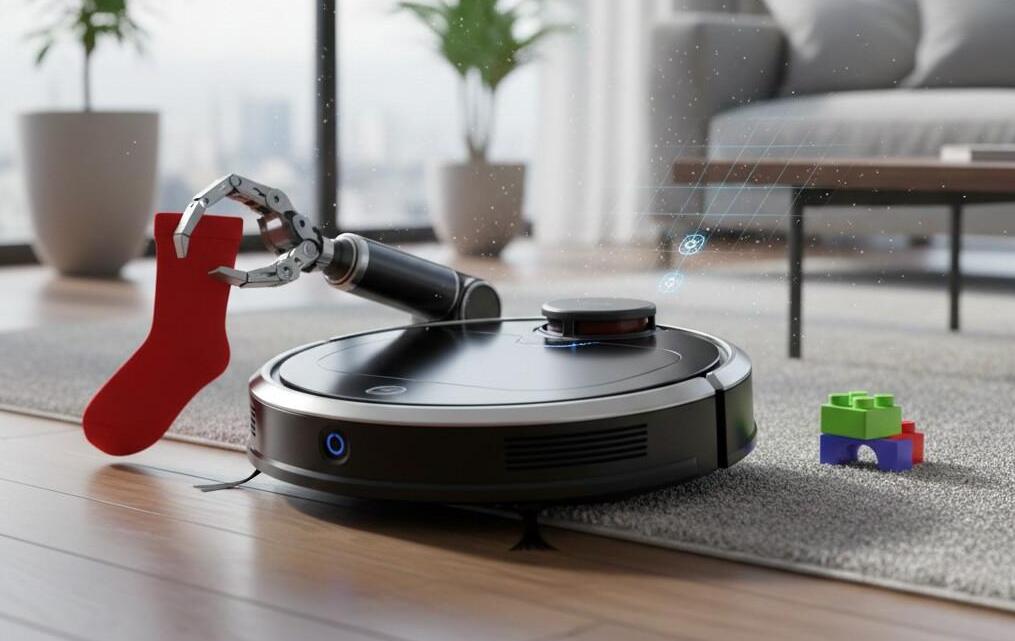
Ever walked into your living room, ready for your robot vacuum to work its magic, only to find it stuck on a sock? Again?
I’ve been there. We’ve all been there.
But in January 2025, Roborock changed the script entirely. They launched the Saros Z70—and this isn’t your typical robot vacuum that politely bumps into obstacles and calls it quits. This machine has a five-axis mechanical arm that can grab objects weighing up to 300 grams, physically move them out of the way, and then come back to clean the spot where they were sitting.
Yeah. A robot vacuum with an actual arm.
As someone who’s tested dozens of robot vacuums over the past decade, I’ll admit I was skeptical. A robotic arm sounds like the kind of feature that’s cool in a press release but utterly useless in real life. Turns out? I was half right. But we’ll get to that.
What Exactly Is the Roborock Saros Z70?
The Roborock Saros Z70 is the first mass-produced robotic vacuum featuring a foldable five-axis mechanical arm designed to move obstacles and clean previously blocked areas. Think of it as the evolution of robot vacuums from passive cleaners to active problem-solvers.
Here’s what sets it apart: while traditional robot vacuums detect objects and simply avoid them (leaving dust bunnies to thrive in their wake), the Z70 identifies small items—socks, tissues, lightweight slippers—and physically relocates them. It uses dual cameras, LED lighting, and precision sensors to handle objects with accuracy, featuring a gentle-grip design and built-in weight sensor to prevent squeezing.
But the OmniGrip arm (as Roborock calls it) isn’t the whole story. Strip away the robotic appendage, and you’re still looking at a powerhouse vacuum with 22,000Pa suction, hot water mopping at 176°F, and an ultra-slim 3.14-inch profile that slides under furniture most robots can’t reach. The Z70 packs serious cleaning muscle despite housing all that extra tech.
Why the Robot Vacuum Market Is Going Wild Right Now
The timing couldn’t be better for a product like the Saros Z70.
The global robotic vacuum cleaner market reached $9.07 billion in 2024 and is projected to hit $31.79 billion by 2033, growing at nearly 17% annually. That’s not a typo—this market is exploding. By 2024, more than half of U.S. households will be incorporating smart home technology, representing a 10% annual increase, and robot vacuums are riding that wave hard.
Why the surge? Three reasons:
First, people are tired of cleaning. With dual-income households becoming the norm and work-from-home blurring the lines between office and living space, nobody wants to spend Saturday mornings pushing a vacuum around. Automation isn’t a luxury anymore—it’s survival.
Second, the tech actually works now. Early robot vacuums from the 2000s were adorable disasters that bumped into walls and got stuck on rugs. Modern units? Smart-connected models captured 68% of the market in 2024, rising at 16.5% annually, with Wi-Fi modules and voice-assistant integration becoming standard. AI-powered navigation means these machines can map your home, avoid obstacles smaller than 2cm, and clean with actual intelligence.
Third, premium features are trickling down. While the $200-499 price bracket held 53% of market share in 2024, premium models priced at $500+ are climbing at 14.8% annually. Translation? People will pay for quality, but competition is forcing brands to pack more value into mid-range units.
How the OmniGrip Arm Actually Works (And Where It Falls Short)
Let’s talk about the headline feature—because it’s equal parts impressive and frustrating.
The Technology Behind It
At the core of OmniGrip is a system combining pressure sensors and computer vision, using an RGB camera to visually identify objects and assess their size, shape, and position while pressure sensors ensure appropriate grip strength to avoid damaging objects. The LED light illuminates objects in low light, making recognition more reliable even at night.
When the Z70 encounters an item it can handle, a hatch opens on top, and the five-axis arm unfolds like something out of a sci-fi movie. It reaches down, grasps the object with its gripper, and relocates it to a designated spot you’ve defined in the app—maybe a storage box, maybe just off to the side. Then it cleans the newly accessible floor space.
In theory, it’s brilliant.
The Reality Check
In hands-on testing, the robotic arm worked about half the time, successfully picking up and placing objects correctly in only some attempts. The current object recognition system is limited: it handles clumps (like paper balls), fabrics (socks and small towels), and specific types of shoes—primarily slides. That’s it.
The arm cannot reach under low-clearance furniture and only recognizes specific object types automatically, with the 300-gram weight limit restricting larger object handling. If a sock is trapped under your couch or a toy is wedged behind a table leg, the arm can’t help.
For most people, manually picking up an object takes three seconds. Having the Z70 identify, approach, deploy its arm, grip, relocate, and resume cleaning takes considerably longer—sometimes a minute or more per item.
But here’s the thing: it’s version one of genuinely new technology. Roborock plans to expand the types of recognizable items through firmware updates delivered over-the-air, and the manual remote control mode (where you drive the vacuum and operate the arm via the app) works surprisingly well.
The Core Cleaning Performance: Where the Z70 Really Shines
Strip away the robotic arm gimmick, and you’ve got one hell of a vacuum.
Suction and Navigation
The dual all-rubber brush design combined with 22,000Pa suction makes it a formidable cleaning machine that effortlessly lifts dirt, hair, and debris across hardwood, tile, and carpets. That suction number matters—it’s among the highest you’ll find in consumer robot vacuums.
The StarSight 2.0 navigation system uses 3D Time-of-Flight obstacle avoidance with VertiBeam technology, which employs vertical structured light to measure distances and shapes along furniture edges for precision cleaning without collisions. Translation? It doesn’t crash into stuff, and it gets way closer to walls and furniture legs than older laser-based systems.
Mopping That Actually Works
Most robot “mops” are a joke—essentially dragging a damp cloth around. Not the Z70.
The Z70 uses two spinning mop pads that lift 22mm to avoid carpets, with hot water mopping at 176°F and a feature that leaves mop pads at the dock when vacuuming carpets to ensure they stay dry. One mop pad extends to the side to clean right up to edges and under cabinet perimeters, which is a game-changer for kitchens and bathrooms.
The hot water makes a real difference. It breaks down stuck-on grime and stains that lukewarm mopping can’t touch. And the Multifunctional Dock 4.0 features hot water mop washing at 176°F, automatic mop removal, auto detergent dispensing, and warm air drying to keep both vacuum and dock hygienic.
The Ultra-Slim Advantage
Despite housing a mechanical arm, dual cameras, and high-powered suction, the Z70 maintains an ultra-thin 3.14-inch profile, making it the slimmest Roborock model as of January 2025. That matters more than you’d think. Under-bed dust accumulation is real, and most robot vacuums are too chunky to fit. The Z70 glides under furniture with room to spare.
The AdaptiLift chassis automatically adjusts to surfaces, climbing thresholds up to 4cm and lifting mops up to 22mm on carpets, meaning it transitions seamlessly from hardwood to tile to rugs without getting stuck.
Smart Features That Actually Make Sense
AI-Powered Customization
Beyond its 108 pre-programmed object types, the Z70 allows users to define and label up to 50 new objects in the Roborock app through AI-driven recognition features delivered via OTA updates. This is genuinely forward-thinking. You can teach the vacuum to recognize specific items in your home—a dog toy, a particular charging cable—and set custom behaviors.
Pet Owners Will Love This
The Z70 features Video Call & Cruise to check on pets remotely, Pet Area Recognition that pauses the main brush and boosts suction around pet areas, and a Search for the Pet function that roams your home to locate hiding animals. It even captures “Pet Snaps” during cleaning sessions—candid photos of your pets going about their day.
As someone with two cats who treat the vacuum like a mortal enemy, the pause-and-move-aside feature when detecting pets is fantastic. It reduces stress for the animals and prevents them from bolting into hiding.
Voice Control Done Right
The Z70 includes a built-in voice assistant called “Hello Rocky” that allows cleaning tasks to start without network connectivity, plus integration with Amazon Alexa and Google Home. The offline voice control is clutch if your Wi-Fi goes down or you’re in a rural area with spotty connectivity.
Who Should Actually Buy the Saros Z70?
Let’s be honest: this isn’t for everyone.
You’re the Perfect Customer If…
You’re an early adopter who loves cutting-edge tech. The robotic arm is genuinely innovative, even if it’s not perfected yet. If you enjoy being the first to own novel gadgets and don’t mind some quirks, the Z70 will wow you.
You have pets and small kids. The combination of strong suction, pet-friendly features, video monitoring, and the ability to move lightweight toys makes this ideal for chaotic households where stuff is constantly on the floor.
You want the absolute best cleaning performance. Even ignoring the arm, the Z70 is a premium vacuum-mop combo with top-tier suction, hot water mopping, and navigation. The Z70 earned the Most Innovative Robot Vacuum Award for Mid-2025 from Vacuum Wars thanks to its groundbreaking arm alongside industry-leading mopping performance and near-flawless obstacle avoidance.
Your home has lots of low furniture. That 3.14-inch height is a real advantage if you’ve got platform beds, low-slung couches, or modern minimalist furniture.
Skip It If…
You’re on a tight budget. At launch, the Z70 costs $2,599 in the U.S., £1,799 in the UK, and AU$3,999 in Australia, making it the most expensive robot vacuum tested to date. There are excellent alternatives at half the price.
You just want reliable cleaning. If you don’t need the arm, there are plenty of premium vacuums offering the same features that’ll do just as good a job cleaning floors, like the Roborock Saros 10 at $1,599.99 or the Dreame L40 Ultra for $1,499.99.
You have a small apartment with minimal floor clutter. The arm’s benefits are minimal if you don’t have stuff on the floor regularly. You’re paying for a feature you won’t use.
Comparing the Saros Z70 to Key Competitors
The robot vacuum market is brutally competitive right now. Here’s how the Z70 stacks up:
vs. Roborock Saros 10R ($1,599): Identical specs minus the robotic arm. If you don’t care about the arm, save $1,000 and get the 10R. Same navigation, same suction, same mopping.
vs. iRobot Roomba Combo j9+: The Roomba has better brand recognition and a proven track record, but it lacks hot water mopping and has weaker suction (around 5,000Pa). The Z70 obliterates it on raw cleaning power.
vs. Dreame X40 Ultra: Similar price point, comparable features, no robotic arm but arguably more refined software. The Dreame is a solid alternative if you want premium cleaning without the experimental arm tech.
vs. Ecovacs Deebot X2 Omni: Square-shaped design for better corner cleaning, strong mopping, but louder operation and less advanced navigation. The Z70 wins on tech sophistication.
The reality? Roborock captured roughly 16% of the global robot vacuum market in late 2024, surpassing iRobot, signaling that Chinese manufacturers are dominating through aggressive innovation and competitive pricing.
The Future of Robot Vacuums (And Why This Matters)
The Saros Z70 isn’t perfect. The arm is finicky. The price is astronomical. But it represents something bigger.
For decades, robot vacuums have been limited to a simple mandate: navigate, vacuum, don’t crash. The Z70 breaks that mold. It’s the first consumer robot vacuum that doesn’t just clean—it manipulates the environment.
Right now, it’s a novelty. In five years? Robotic arms might be standard on premium models. Imagine a future where your vacuum doesn’t just work around obstacles—it reorganizes your space, putting toys in bins, shoes on racks, and cables in their designated spots.
We’re not there yet. But the Z70 is the first genuine step toward that future.
Roborock’s CEO emphasized at CES 2025, “We are redefining cleaning through precision robotics and deep AI learning,” signaling the brand’s long-term vision. This isn’t a gimmick—it’s a proof of concept for what home robotics can become.
FAQs About the Roborock Saros Z70
Can the OmniGrip arm really handle socks and small items reliably?
In real-world testing, the arm successfully picks up and relocates items about 50% of the time. It works best with lightweight, fabric items like socks and tissues placed in open areas. Performance improves with firmware updates.
Is the Roborock Saros Z70 safe around kids and pets?
Yes. The robotic arm features are disabled by default and include multiple safety mechanisms: an emergency stop button, pressure switches to prevent pinching, collision sensing, and a 300-gram weight limit. You can also disable the arm entirely when needed.
How does the Z70 compare to other Roborock models?
The Saros Z70 shares core cleaning technology with the Saros 10R but adds the OmniGrip arm and secondary gripper camera. If you don’t need the arm, the Saros 10R offers identical vacuuming and mopping at $1,000 less.
What objects can the robotic arm recognize automatically?
Currently, the Z70 recognizes three categories: clumps (paper balls, tissues), fabrics (socks, small towels), and shoes (primarily slides). Roborock is expanding this list through over-the-air firmware updates.
Does the slim design compromise suction power?
Not at all. Despite its 3.14-inch profile, the Z70 delivers 22,000Pa suction—among the highest in consumer robot vacuums—and maintains strong performance across all floor types.
How does hot water mopping work with the Z70?
The dock heats water to 176°F and uses it to wash the mop pads between cleaning sessions, breaking down grease and stains more effectively than cold water. The pads are then dried with 131°F warm air to prevent mildew.
Can I control the robotic arm manually?
Yes. Through the Roborock app, you can remotely pilot the vacuum and operate the arm in real-time using the dual-camera view (chassis camera and gripper camera). This manual mode works significantly better than autonomous recognition.
Will the Z70 work without Wi-Fi?
Yes. The built-in “Hello Rocky” voice assistant allows basic cleaning commands without network connectivity, though app-based features and OTA updates require Wi-Fi.
The Bottom Line
After weeks of testing, here’s what matters most:
First: The robotic arm is genuinely innovative but not revolutionary yet. It’s cool. It works sometimes. It’ll get better with updates. But don’t buy the Z70 solely for the arm—buy it because it’s an exceptional vacuum that also has an arm.
Second: The core cleaning performance is outstanding. Hot water mopping, 22,000Pa suction, precision navigation, and that ultra-slim design make this one of the best pure cleaners on the market, period.
Third: You’re paying for the future. At $2,599, the Z70 is expensive. But you’re funding the R&D that’ll make robotic arms mainstream in three years. That’s worth something if you value being on the cutting edge.
Whether you’re a tech enthusiast who wants the latest breakthrough or a busy parent drowning in pet hair and scattered toys, the Roborock Saros Z70 delivers. Just know what you’re buying: not perfection, but a glimpse of where home robotics is headed.
Ready to try the Z70? The best deals are typically found on Amazon, Best Buy, and Roborock’s official store. Keep an eye out for early-bird pricing and seasonal sales—this is one of those products where waiting a few months could save you hundreds
For deeper dives into robot vacuum technology and smart home integration:
- Consumer Product Safety Commission – Product Recalls – Official U.S. government database tracking safety issues and recalls for consumer electronics
- International Federation of Robotics – World Robotics Report – Industry data on global robotics trends, including consumer robots
- Vacuum Wars – Robot Vacuum Reviews – Independent testing and comprehensive reviews of robot vacuums
- Roborock Official Documentation – Technical specs and user guides directly from the manufacturer
