




Meta: Discover why GPT-generated content often feels mechanical—and how AI humanizers fix rhythm, tone, and detectability issues to make your blog sound naturally human.
Introduction: The Paradox of Fast AI Content That Still Feels Wrong
It wasn’t long ago when the mere prospect of writing a draft in under a minute could cause the sort of anxiety that writers have fought all their lives. Then GPT came along and made the text appear in seconds. The black page anxiety didn’t exist for a very long time, and suddenly your writers were editors instead of creators-from-scratch. It was so good, in fact, that entire workflows were redesigned around the new AI drafting capability, from niche site building to enterprise-level SEO content production.
But there’s a problem we all know about. When you paste the content into your editor, something feels off. The sentences are correct. The structure is clean. But the tone is unmistakably machine-made. Readers notice it. Google’s quality thresholds notice it. The traffic drops.
In this article, we look at the hidden problem behind GPT-generated text that still feels “AI-written,” why that matters for SEO and authenticity, and how Humanize AI technologies – such as GPTHumanizer AI – re-write that text into naturally human, detection safe writing.
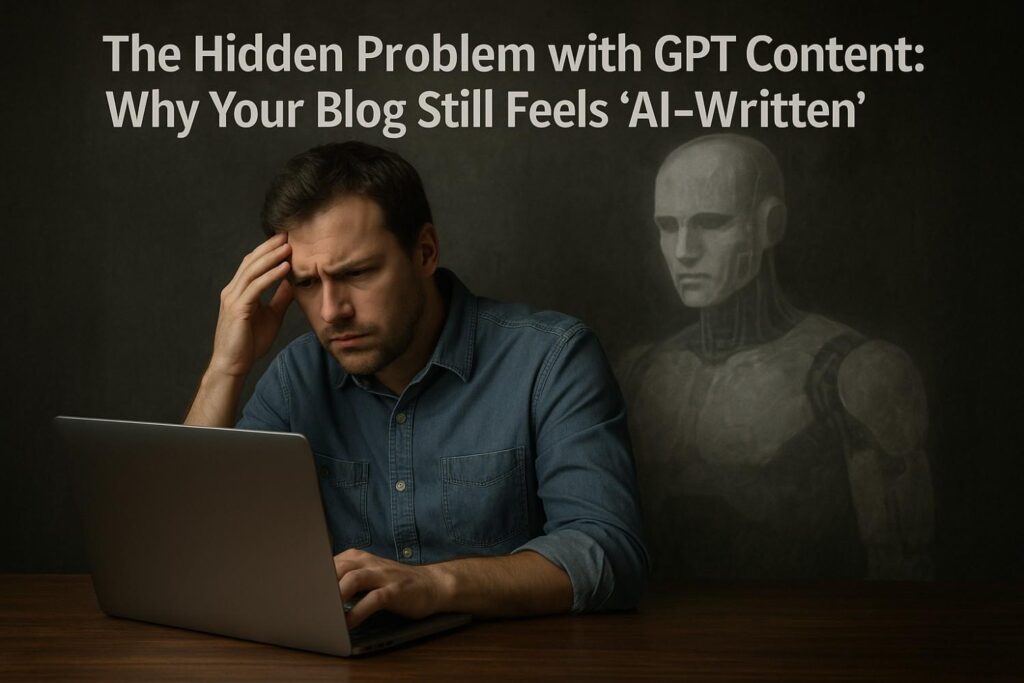
Why GPT Content Sounds Predictably AI-Like
There’s no need to be a professional writer. You can recognize when something “sounds AI.” The reason is simple, not magic, but predictable repetition. By predicting the statistically most likely next word, GPT models write in a way that is technically coherent but rhythmically flat.
GPT writes with a statistically safe, neutral vocabulary, middle-of-the-road sentence structure, and the same transitions. So, if you produce twenty blog intros with GPT, they will all start with:
- “In today’s fast-paced digital world …”
- “Furthermore …”
- “Additionally …”
- “Moreover …”
The patterns repeat because they are statistically safe, not because they are good storytelling. Humans, in contrast, write with uneven rhythms, spontaneous phrasing, and vocabulary that is specific to their context.
Why this matters for SEO and bloggers
Google doesn’t really punish “AI content,” but it does respond to low-quality, bland writing that fails to demonstrate experience and authority.
Mechanical writing hurts in several ways:
- Readers will skim instead of engage.
- Your average scroll depth will take a hit.
- Your time on page will dwindle.
- Your E-E-A-T signals will fall.
Blogs that sound like GPT output tend to get stuck below the first page of search results because the writing doesn’t feel like experience backed up with data. And when you submit the writing to any number of detectors, the repeated syntactic signals make it appear more likely that the text is machine-generated (even if your writer spent hours fine-tuning it).
The result is that your idea is yours, but your writing still sounds (to the human reader) like it came from GPT.
The Hidden Cause: Probability Patterns, Not Bad Writing
To understand the problem, you need to understand how GPT “thinks.” It doesn’t write. It predicts.
Given an input sentence, GPT picks the next token according to probability distribution. This means:
- It avoids risky or emotionally charged expressions.
- It sticks to structures that appear all over its training data.
- It smooths out irregularities that come up in human writing.
Its goal isn’t to sound human. Its goal is to sound statistically average. That is why its output feels bland, unembellished, and mechanical compared to that of a real writer.
Why Simple Paraphrasing Doesn’t Solve the Problem
Many bloggers try to fix GPT tone by running it through a paraphraser. But paraphrasers work on the surface. They replace words with synonyms or change verb tense, rearrange a few transition words, and so on.
The deep structure—the part that feels “AI”—remains unchanged. Paraphrased text still preserves GPT’s:
- Even pacing
- Template-like structure
- Repetitive transitions
- Emotionally neutral tone
So while paraphrasing can reduce plagiarism or create variation, it does not Humanize AI text. The output still reads like a machine trying to be clever.
How Modern Humanizers Rewrite Text (Not Just Rephrase It)
This is where the AI humanizer is different. Its goal isn’t to “make the text different.” Its goal is to make the text feel natural.
Humanizers rewrite the text in a multi-layer way, working on the structure, the tone, the rhythm and pacing, and the semantics.
- Not just word replacement: Instead of just changing a word, a humanizer reorders the clause, or changes the sentence flow. It also works on the structure of paragraphs.
- Not just changing transitions: Instead of adding synonyms for a word, a humanizer changes the phrase and the transitions between sentences.
- Pacing and rhythm: Instead of evenly pacing sentences, humanizers add irregular rhythm, the “burstiness” that humans use in writing.
- Tone: Humanizers adjust the tone for intent – for blog writing, brand voice, or academic text.
- Semantics: Unlike paraphrasers, humanizers preserve the semantics of your original writing. And for a reason: your actual input text is your idea.
Where GPTHumanizer AI Fits In
GPTHumanizer AI is an example of a modern system that is designed specifically for the Humanize AI task. Instead of doing word-to-synonym replacements, it works on multiple levels of rewriting, including sentence rhythm, pacing, and structure. Plus, the way that the humanizer preserves semantics is a bonus for SEO content, and brand consistency.
Because it offers Lite, Pro, and Ultra models, the user can choose between changing style only (Lite) or also changing structure (Ultra). GPTHumanizer AI is part of a class of tools that rewrite the predictable patterns in GPT text, not just disguise them.
Practical Example: Before and After Humanization
Before (GPT-style):
“In today’s fast-paced digital landscape, businesses must adapt quickly. Additionally, AI tools have transformed how writers create content. Moreover, these technologies offer new opportunities for productivity.”
After (Humanized):
“The pace of digital work keeps accelerating, and businesses now feel that pressure daily. AI hasn’t just sped things up—it’s changed how writers plan, draft, and refine ideas. The opportunities are real, but so are the growing pains.”
Paraphrased Text vs Humanized Text
- Paraphrased: “Businesses must adapt rapidly to keep up with the digital world. AI tools have changed how content is created. These innovations have opened up new paths for efficiency.”
- Humanized: “The pace of digital work keeps accelerating, and businesses now feel that pressure daily. AI hasn’t just sped things up—it’s changed how writers plan, draft, and refine ideas. The opportunities are real, but so are the growing pains.”
Why Natural Writing Does Better for SEO
When text feels like it came from a real person, engagement improves:
- Readers stay longer.
- The content builds trust.
- Google sees stronger E-E-A-T signals.
- The writing reflects real experience rather than template-like generalities.
In other words, the more natural the text, the better it performs—both for algorithms and for readers.
Conclusion: GPT Gives Speed, Humanizers Give Authenticity
GPT gives speed. It gives you a good first draft, but it leaves a recognizable texture that can hurt your SEO, credibility, and detection rates.
Humanize AI, by contrast, takes the raw output from GPT and replaces the structural and tonal limitations of that text with something that feels naturally human and passes quality thresholds.
In the future, the writer’s workflow won’t be “AI vs humans.” It won’t be even. It will be layered: AI draft → humanizer rewrite → human refinement → publish. In that workflow, authenticity is intentional, not accidental.
