
An online business can have a strong product, a professional website, and a clear offer and still struggle to attract consistent customers.
The problem is not always a lack of marketing. Often, different marketing activities are being handled separately without a clear connection between visibility, traffic, conversions, and business goals.
That is where a Digital Marketing Agency can provide value.
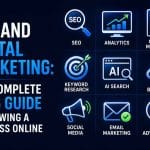
A capable agency can bring together SEO, content marketing, paid advertising, social media, analytics, conversion optimization, and lead generation. More importantly, it can help determine which activities deserve attention and how their results should be evaluated.
However, hiring an agency should not be treated as an automatic requirement for every online business. The better question is:
Can external marketing expertise and execution solve a problem that the business cannot efficiently solve internally?
That question provides a much more practical starting point.
What Does a Digital Marketing Agency Actually Do?
A Digital Marketing Agency helps businesses plan, execute, measure, and improve online marketing activities.
Depending on the business and agency, services can include:
- Search engine optimization (SEO)
- Content marketing
- Paid search advertising
- Social media marketing
- Email marketing
- Website optimization
- Landing-page optimization
- Conversion tracking
- Lead generation
- Analytics and reporting
- Local SEO
- Online reputation management
These activities should not necessarily operate independently.
For example, SEO may bring a prospective customer to a website, but a confusing landing page can make that traffic less useful. Similarly, an advertising campaign may generate clicks, but inaccurate tracking can make it difficult to determine whether those clicks contributed to meaningful customer actions.
Analysis: The value of an agency is therefore not simply the number of services it offers. Its value can come from connecting the right activities to the right business objective.
Why Online Businesses Need More Than Just Website Traffic
Website traffic is useful, but traffic itself is not the final objective for most businesses.
A company generally wants visitors to do something meaningful, such as:
- Purchase a product
- Submit an enquiry
- Request a quotation
- Book an appointment
- Register for an account
- Contact the sales team
- Subscribe to a service
This distinction changes how marketing should be evaluated.
A business receiving thousands of visitors but very few meaningful customer actions may have a different problem from a business receiving fewer but highly relevant visitors.
For measuring marketing performance, Google Analytics allows businesses to identify important customer actions as key events and evaluate the touchpoints that contribute to those actions. Its Google Analytics key-event measurement for business outcomes documentation explains how businesses can use these measurements to understand important user actions.
This is why a good marketing strategy should move beyond:
Traffic → Traffic → More Traffic
and instead consider:
Relevant Traffic → Useful Experience → Meaningful Action → Measurement → Improvement
1. A Digital Marketing Agency Can Bring Multiple Skills Together
Digital marketing is not a single discipline.
SEO, paid advertising, content strategy, analytics, social media, and conversion optimization require different types of knowledge.
A growing business could build an internal team for each discipline, but that also creates recruitment, management, training, and coordination responsibilities.
An agency may provide access to several specialists through one external relationship.
This can be particularly useful when a business needs multiple capabilities but does not need every specialist working full-time.
However, outsourcing is not automatically cheaper than hiring internally. The more useful comparison is the value of the expertise, execution capacity, speed, and strategic coordination the business receives.
Agency vs. In-House Marketing
| Factor | Digital Marketing Agency | In-House Team |
|---|---|---|
| Specialist skills | Access to multiple specialists may be easier | Skills must be developed or recruited |
| Business knowledge | Must be developed through collaboration | Usually closer to the business |
| External perspective | Often a strength | May be more limited |
| Management | External relationship required | Direct internal management |
| Scalability | Can add specialist support as needed | Usually requires additional hiring |
| Brand familiarity | Develops over time | Usually strong from the beginning |
| Best use case | Need for external expertise or execution | Need for dedicated internal ownership |
Analysis: There is no universal winner. The appropriate model depends on the company’s size, capabilities, objectives, budget, and need for internal control.
A hybrid model can also work: internal employees retain customer and brand knowledge while an external agency handles specialist areas such as SEO, paid advertising, analytics, or content.
2. SEO Can Become a Structured Long-Term Activity
Search engine optimization is often misunderstood as simply adding keywords to pages.
In practice, an SEO program can involve:
- Understanding search intent
- Improving website structure
- Creating useful content
- Improving internal linking
- Addressing technical issues
- Optimizing page titles and descriptions
- Improving relevant page content
- Monitoring search performance
- Updating content when appropriate
Google’s Search Central guidance emphasizes helpful, reliable, people-first content and recommends creating content that provides original information, research, or analysis rather than simply summarizing existing pages. The Google people-first content guidance for SEO also explains that content should primarily be created to benefit people rather than manipulate search rankings.
That principle has an important implication for businesses.
A digital marketing agency should not be evaluated merely on how many articles it publishes. It should be able to explain why particular content is useful to the intended audience and how it supports the site’s purpose.
A Better SEO Question
Instead of asking:
“How many blogs will you publish every month?”
ask:
“What customer questions are we answering, what search intent do they represent, and what additional value will our content provide?”
That question encourages a more useful SEO strategy.
3. Paid Advertising Requires More Than Launching Campaigns
Paid advertising can provide an online business with another route to potential customers.
But creating an advertisement is only one part of the process.
Campaign performance can depend on:
- Audience selection
- Search intent
- Ad messaging
- Creative
- Landing-page quality
- Budget allocation
- Conversion tracking
- Testing
- Ongoing optimization
This is another area where measurement matters.
If a business only measures impressions and clicks, it may know that people interacted with advertisements without knowing whether those interactions contributed to valuable business actions.
Example: A Lead-Generation Business
Illustrative example — not a documented case study:
Imagine a consulting company running search advertisements.
A visitor clicks an advertisement, reads a service page, visits a second page, and eventually submits a consultation form.
If the company only reports the initial click, it knows that the advertisement generated traffic.
If the form submission is properly measured as a key event, the company can instead investigate the journey toward the business action.
That creates a more useful decision-making process:
Advertisement → Landing Page → Engagement → Enquiry → Measurement
The agency’s job is not merely to generate the first click. It should help the business understand what happens afterward.
4. Content Marketing Should Provide a Reason to Choose Your Business
Publishing content is easy.
Creating content that genuinely helps a potential customer make a decision is harder.
Useful business content might:
- Explain a complicated process
- Compare legitimate alternatives
- Answer common customer questions
- Explain product limitations
- Clarify pricing factors
- Help users identify the right solution
- Address common implementation problems
- Explain what customers should consider before purchasing
This creates an important distinction between content production and content usefulness.
Google’s people-first guidance asks whether readers will leave feeling they have learned enough about the topic to help achieve their goal.
Information gain: One practical way to evaluate proposed content is to ask:
“What will the reader know after reading this that they could not reasonably determine from a typical competing page?”
If the answer is unclear, the topic may need stronger research, original analysis, better explanation, or more useful supporting information.
5. Social Media Should Have a Defined Job
Social media marketing is often treated as a requirement simply because customers use social platforms.
But businesses should identify what role a particular platform is expected to play.
Depending on the business, social media might support:
- Brand awareness
- Product discovery
- Community interaction
- Customer communication
- Content distribution
- Customer education
- Lead generation
Not every business needs to prioritize every platform.
A useful agency should be able to explain:
Audience → Platform → Objective → Content → Action → Measurement
If the agency cannot explain why a particular social channel is appropriate, the business should question whether the proposed activity is strategic or simply routine content production.
6. Conversion Optimization Connects Marketing to the Website
Imagine an online business successfully attracting relevant visitors but losing potential customers because the website makes the next step unclear.
The marketing problem may not be traffic.
It may be conversion friction.
Potential areas to examine include:
- Unclear calls to action
- Confusing navigation
- Weak product explanations
- Poorly structured landing pages
- Unnecessary form fields
- Missing trust information
- Difficult mobile experiences
- Slow or technically problematic pages
Analysis: This is why increasing traffic should not always be the first response to weak results. Sometimes improving the experience for existing relevant visitors is the more logical problem to investigate.
A Digital Marketing Agency with conversion and analytics capabilities can help identify where users are dropping out and prioritize potential improvements.
7. Measurement Should Be Designed Before Scaling
One of the most useful agency-selection principles is simple:
Do not scale what you cannot meaningfully evaluate.
Consider a hypothetical online business that wants to increase its advertising budget.
Before increasing spending, the business should understand:
- What customer action matters?
- Is that action being tracked?
- Is the tracking reliable?
- Which campaigns contribute to that action?
- What happens after the customer converts?
- Which information will influence the next marketing decision?
This creates a practical measurement workflow:
Business Goal → Important Action → Tracking Setup → Campaign → Data → Analysis → Decision
That workflow is more useful than simply producing monthly reports full of disconnected numbers.
8. A Digital Marketing Agency Can Save Internal Time
Business owners and internal teams have many responsibilities beyond marketing.
They may need to manage:
- Products
- Customers
- Operations
- Sales
- Finance
- Suppliers
- Employees
- Business development
Managing SEO, advertising, content, analytics, and social media on top of those responsibilities can become difficult.
An agency can take responsibility for some of the execution while the business retains strategic oversight.
However, outsourcing does not mean the business should stop participating.
The company still needs to provide:
- Business priorities
- Customer knowledge
- Brand requirements
- Product information
- Sales feedback
- Approval
- Performance feedback
The agency brings marketing expertise; the business brings context.
The two should work together.
9. Professional Reporting Can Improve Decision-Making
A useful agency report should answer more than:
“What did we do this month?”
It should also help answer:
“What happened, why might it have happened, and what should we do next?”
For example:
| Reporting Question | Useful Interpretation |
|---|---|
| What changed? | Identifies movement |
| Why might it have changed? | Provides analysis |
| Which activity contributed? | Connects activity to outcomes |
| What did we learn? | Captures information gain |
| What should happen next? | Creates an actionable decision |
This approach makes reporting a management tool rather than a document created only to demonstrate activity.
10. Businesses Should Be Careful With Marketing Promises
An agency’s promises should be evaluated carefully.
Claims such as guaranteed rankings, guaranteed sales, or guaranteed advertising performance involve outcomes influenced by factors outside an agency’s complete control.
More generally, the Federal Trade Commission’s advertising substantiation requirements for objective claims state that advertisers and advertising agencies should have a reasonable basis for objective advertising claims before they are disseminated.
That provides a useful standard when assessing agency marketing claims.
Ask:
- What evidence supports this claim?
- What exactly is being guaranteed?
- What conditions apply?
- Which parts are within the agency’s control?
- How will success actually be measured?
An agency that explains uncertainty clearly may be more credible than one that promises outcomes without explaining the conditions behind them.
When Should an Online Business Hire a Digital Marketing Agency?
An agency may be worth considering when:
- Marketing responsibilities are becoming difficult to manage.
- Several specialist skills are required.
- Existing marketing efforts lack consistency.
- The company needs better analytics or measurement.
- Paid campaigns require specialist management.
- SEO needs structured long-term attention.
- Internal employees do not have sufficient time.
- The business has a clear offer and target customer.
- The company has a defined objective for marketing investment.
However, an agency may not be the right first step when:
- The product is still being validated.
- The target customer is unclear.
- There is no defined business objective.
- The business only needs a small one-time task.
- There is no realistic budget for sustained activity.
- Management expects marketing to solve a fundamentally weak product or offer.
The Decision Framework
Use this four-step framework before hiring:
Step 1: Identify the bottleneck
Is the problem visibility, traffic quality, conversion, measurement, retention, or execution capacity?
Step 2: Determine the required capability
Do you need SEO, paid advertising, content, analytics, conversion optimization, or several of these?
Step 3: Compare internal and external options
Could the existing team realistically solve the problem? Would hiring internally provide better long-term value?
Step 4: Define the measurement system
What business action will determine whether the work is helping?
This framework prevents the common mistake of purchasing marketing services before identifying the actual problem.
How to Choose the Right Digital Marketing Agency
Look for diagnosis before recommendations
A strong agency should want to understand the business before prescribing a fixed solution.
Ask:
“What would you investigate during the first stage of the engagement?”
The answer can reveal how strategically the agency approaches problems.
Evaluate the measurement approach
Ask what the agency considers a meaningful result.
Do not accept a list of metrics without understanding why those metrics matter.
Examine the communication process
Find out:
- Who will manage the account?
- How often will you receive reports?
- How are strategic decisions communicated?
- Who approves major changes?
- How are problems escalated?
Ask how strategy changes when evidence changes
Marketing rarely remains static.
If search behavior changes, a campaign underperforms, a product changes, or customer feedback reveals a new issue, the strategy should be capable of adapting.
Avoid agencies that rely on unsupported certainty
An agency should be able to distinguish between:
What is known → What the data suggests → What should be tested next
That is generally more useful than presenting every forecast as a guaranteed outcome.
Three Genuine Information-Gain Tests for Your Agency
Before approving a strategy, ask the agency to answer these three questions.
Test 1: What will you stop doing?
A good strategy is not only about adding activities.
If the agency cannot identify low-value or poorly aligned activities that should be reduced or stopped, the plan may simply be adding more work.
Test 2: What will we learn?
Every major campaign should produce useful information, even if the result is weaker than expected.
The learning might concern:
- Audience quality
- Search intent
- Content usefulness
- Landing-page friction
- Advertising messages
- Product positioning
Test 3: What decision will the data change?
A metric is more useful when it can influence a decision.
For example:
Data: A landing page receives relevant traffic but few enquiries.
Possible decision: Investigate page messaging, calls to action, form friction, trust information, and user intent before simply buying more traffic.
This is a more disciplined approach than assuming every performance problem requires additional advertising spend.
Final Thoughts
Every online business does not automatically need a Digital Marketing Agency.
An agency becomes valuable when it can solve a clearly identified problem through specialist expertise, coordinated execution, measurement, and continuous improvement.
The strongest reason to hire one is therefore not:
“Everyone is doing digital marketing.”
It is:
“We have a defined marketing problem, and external expertise can help us solve it more effectively.”
Before choosing an agency, identify the bottleneck, establish the business outcome that matters, determine how that outcome will be measured, and then select the capabilities required to address it.
For SEO, that means looking beyond keyword volume and publishing frequency toward useful, people-first content and genuine information value. For advertising, it means connecting campaigns with meaningful customer actions. For reporting, it means turning data into decisions rather than simply presenting numbers.
Ultimately, a good Digital Marketing Agency should not make marketing feel more complicated. It should make the business’s marketing decisions clearer, more measurable, and more purposeful.